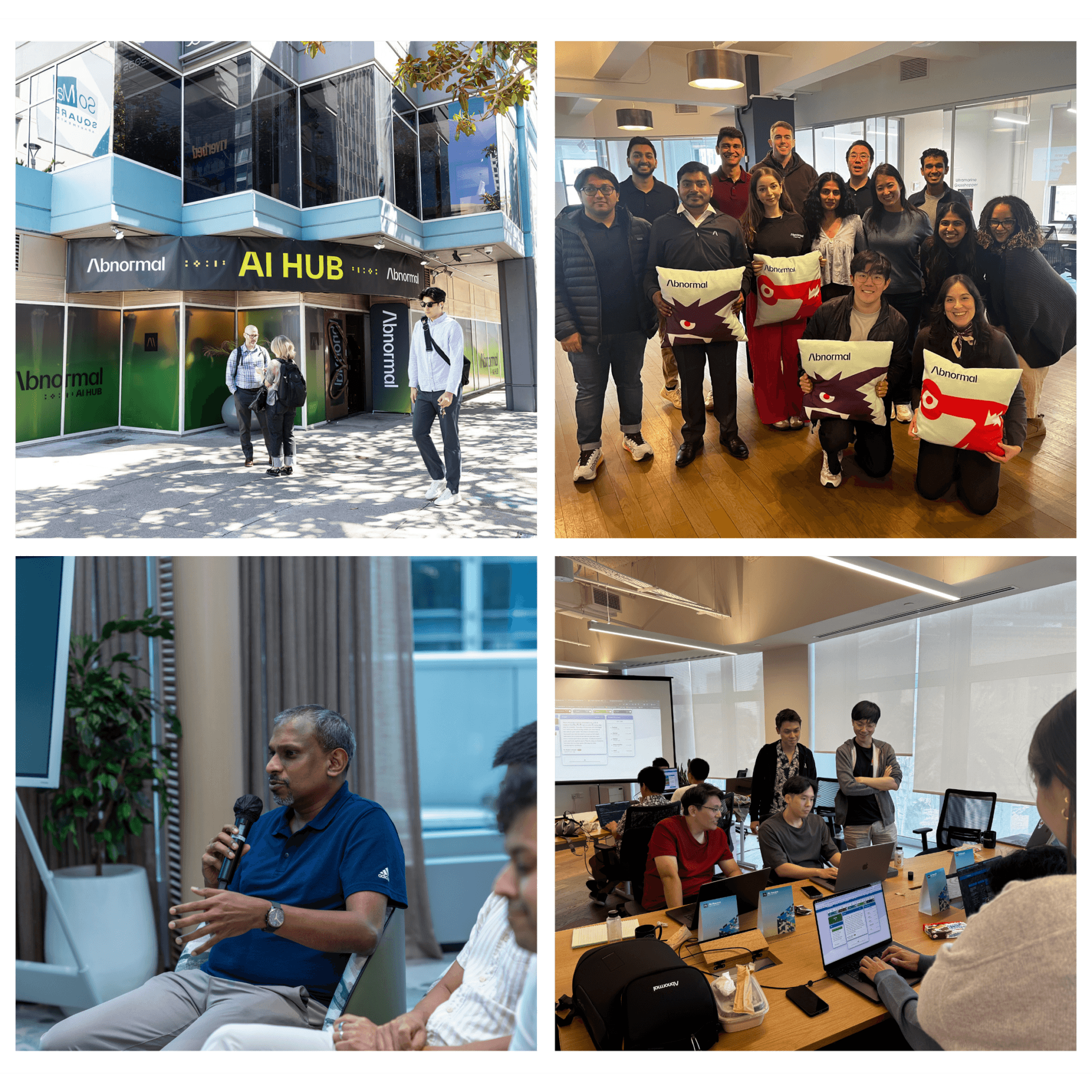
At Abnormal, being AI-native isn't a product claim. It's an expectation that extends to every role, every team, and every workflow. The company didn't bolt AI onto an existing way of working — it built from scratch around what AI makes possible. That means everyone, not just engineers, is expected to explore, experiment, and find better ways to do their work.
AI Day is what that expectation looks like in practice. It's a dedicated day added to team offsites where employees get structured time to build with AI tools — not in the abstract, but applied to real problems from their actual work — with an AI Champion facilitator in the room to help.
"AI Day is a dedicated hands-on experience built into team offsites across R&D — no slides, no theory, just teams applying AI to their real work and challenges, with AI Champions in the room to make it feel safe," said Chanel Green, Technical Program Manager. "The original proposal was designed with one main goal in mind: put the user first. Because while trainings are great, people learn by doing — and they need dedicated, protected time to actually do it. We're iterating on every AI Day we run, learning what works, and building toward something we'd love to scale."
Earlier this year, Abnormal's Technical Program Management team ran the first pilot at their offsite. Eleven TPMs dedicated time to explore AI tools alongside peers and a live facilitator, applying them to real problems from their own work. The format was intentional: learn by doing, in a psychologically safe environment where experimentation was the point. Not theory. Not training. Real problems, real tools, real output.
At the end of the day, three projects were selected by a panel of judges — Kevin Wang, SVP of Engineering; Mahfujul Hoque, Technical Program Manager; and Ivan Penev, Software Engineer — using three criteria: novelty and creativity, business impact, and depth of AI usage. What they found were tools that were already ready to use.
Building for the Work in Front of You
The projects that stood out weren't abstract proofs of concept. They were solutions to problems their builders lived with every week.
Hala Abualtayeb, Associate Manager of Technical Program Management, built Customer Pulse — a unified planning tool that answers a deceptively simple question: what are customers feeling right now?
The problem she was solving had three layers. Teams couldn't see emerging patterns before they became escalations. Critical context like ARR and customer health score was scattered across tools. And escalations themselves were dense and unstructured, making them hard to group into meaningful themes at volume.
"Planning today is reactive," Hala explained. "Themes only surface when a customer escalates, and by then the pain is acute and the chance to address it proactively has passed."
Customer Pulse pulls bugs, feature requests, and Gainsight Risk escalations from across systems, uses an LLM to cluster them into themes, and enriches each one with customer metadata including ARR, customer health, and customer count. The result is a structured, business-grounded view for product managers and engineering managers heading into quarterly planning.
"Aggregating data at that scale and making sense of it was impractical to do by hand, but with these tools it's within reach — and it's the enrichment that turns raw volume into impact."
Rohan Talathi, Technical Program Manager for the Identity Program, built something with a different goal: make a process fully self-service, with no dependencies on any single person to run it.
The CDDv2 Dashboard solves a visibility problem in customer data storage compliance. Across 500+ database components, the owning team had no single place to see their components' data storage compliance, which had approved exemptions, and which teams still needed to act. Stats were pulled manually. Exemptions lived buried in code. Slack reminders were sent by hand with no record of what went out or when.
"It was a high-friction, error-prone process that consumed engineer time every single week," Rohan said.
His dashboard connects directly to the source repository, parses all manifest files on demand, caches the output, and gives anyone a live view of data posture with filtering, trend tracking, and built-in Slack reminders. Once running, it runs itself.
"I wanted to build something genuinely self-service — no dependencies on me or anyone else to run it, and no manual steps to get value out of it."
From Idea to Working Tool
Both Hala and Rohan came away with something more than a finished project. They came away with a new sense of what's within reach.
For Hala, the shift was about what AI can do with messy, scattered data. "The real learning is realizing AI can do the aggregation and the contextualizing together," she said. "So decisions get grounded in business impact rather than ticket volume or gut feel." She also took home a habit: time spent upfront on structure and scope pays off significantly in execution speed and quality. "The projects that came together fastest were the ones with the clearest scope going in."
For Rohan, the unlock was Claude Code — specifically what becomes possible when an AI tool has real context about the systems you're actually working in. "Having a tool that can directly access the codebase changes what's possible," he said. "A lot of what I built on AI Day showed me how much faster I can move when the AI has real context about the specific systems and programs I'm running, rather than working from descriptions alone."
Both walked out energized. Hala described leaving "motivated and genuinely excited about what's possible." Rohan put it more directly: "Honestly, just that feeling that everything is possible. You name it, there is a way to build it."
What AI-Native Looks Like in Practice
Neither Hala nor Rohan described AI as a tool they use occasionally. They described it as a different way of working.
For Hala, being AI-native means reaching for AI first to take the redundant, repeatable work off her plate. "So much of any given week is mechanical: pulling data from across systems, formatting status updates, parsing dense tickets, stitching context together from a dozen tools," she said. "Handing more of that to AI helps free me up for the work where I can add the most value." She's increasingly building agentic workflows to handle the operational scaffolding — gathering inputs, drafting status, flagging what's off — so she can step in for the judgment calls.
For Rohan, AI-native means everyone is equipped and encouraged to move faster and do more than their role traditionally allowed. "I have seen product development timelines shrink from quarters to weeks," he said. He offered a concrete example: showing up to a design review with a near-perfect mock without going to a designer. The bar isn't just access to tools — it's being pushed to actually use them.
"A lot of companies say they are AI-native but very few actually are. At Abnormal, regardless of your role, you have access to some of the latest AI tools and are genuinely encouraged to weave them into your everyday work."
What This Pilot Proved
AI Day is still early. The TPM offsite was the first pilot, with plans to expand to engineering offsites across R&D in the coming quarters. But what this day proved is already clear: when people have dedicated time, real problems to work on, and the right environment to experiment, they build things that matter.
The tools Hala and Rohan built weren't demos. They were solutions their teams could pick up and use. That's the point — and it's the bar AI Day is designed to reach every time.
"What surprised me most was how far I could actually get — going from an idea to a working tool that wires across our real systems and adds value to our teams."
