Forged email is a stubborn problem, and DKIM is one of the quieter tools working in the background to keep it in check. It gives receiving servers a way to confirm that a message really came from the domain it claims to, which is the foundation that the rest of email trust is built on.
Key Takeaways
- DKIM adds a digital signature to outgoing email so receiving servers can verify the sending domain and check whether the message changed in transit.
- DKIM works best with SPF and DMARC because a signature alone does not tell receiving systems how to handle failed authentication.
- Weak keys, poor key rotation, and DNS mistakes can quietly reduce the protection DKIM is supposed to provide.
- DKIM improves email trust while leaving replay attacks, compromised accounts, and mailing list modifications outside its protection.
How DKIM Cybersecurity Works in Email Authentication
DKIM works by attaching a digital signature to outgoing email and giving receiving servers a way to verify that signature against a public key in DNS.
Signing the Outgoing Message
When a mail server sends a DKIM-signed email, it follows a specific sequence described in RFC 6376. First, the server selects which email headers to include in the signature, such as the From, Subject, and To headers. It applies a canonicalization algorithm to normalize the headers and body, then computes a SHA-256 hash of the canonicalized body and stores it in the body hash tag of the signature.
With the body hash calculated, the server builds the DKIM-Signature header with all required tags and leaves the signature field temporarily empty. It hashes the selected headers along with this partially built signature, then signs the resulting hash using the domain's private key. The final base64-encoded signature populates the signature field, and the server prepends the completed header to the message. The private key never leaves the sending server; only the mail transfer agent software should have read access to it.
Verifying the Signature on Receipt
The receiving server extracts the DKIM-Signature header and parses its tag-value pairs to identify the signing domain, selector, algorithm, and other parameters. Using the selector and domain values, it constructs a DNS query that combines the selector with a fixed DKIM identifier and the signing domain to retrieve the public key from the sender's DNS TXT record as specified in RFC 6376.
Once it has the public key, the receiving server applies the same canonicalization specified in the signature, recomputes the body hash, and compares it to the body hash value carried in the signature. If the body hash matches, the server uses the public key to verify the cryptographic signature; a mismatch at either step means the message was altered after signing. Under RFC 6376, a successful verification means the signing domain took responsibility for the message. The server then reports a DKIM pass or fail result, which downstream systems like DMARC use to decide what happens next.
Anatomy of a DKIM Signature
A DKIM signature is the set of tags that tells a receiving server how to find the public key and verify a signed message.
The DKIM-Signature header contains every parameter a receiving server needs to locate the public key and validate the message. The public key itself is published in a DNS TXT record at a location built from the selector and the signing domain. That record includes a version tag identifying it as DKIM1, a key type tag specifying either RSA or Ed25519 per RFC 8463, and a public key tag holding the base64-encoded public key. Setting the public key tag to an empty value signals that the key has been revoked.
Required Tags in Every Signature
A complete DKIM-Signature header carries a defined set of parameters. The version tag identifies the DKIM version in use. The algorithm tag declares which hashing and signature algorithm produced the signature, typically RSA paired with SHA-256. The domain tag names the signing domain where the public key resides in DNS, and the selector tag identifies which specific key under that domain should be used for verification. Together, the selector and domain form the DNS query that retrieves the correct public key.
The canonicalization tag controls how strictly headers and body whitespace are normalized before hashing. The relaxed setting for both headers and body tolerates minor formatting changes during transit. The header tag lists which headers were included in the signature; any header not on that list can be modified without invalidating the signature. The body hash tag carries the hash of the canonicalized message body, used to detect tampering, while the signature tag carries the digital signature itself, generated by signing the selected headers and body hash with the private key.
Two optional tags add important security controls. A timestamp tag records when the signature was generated, while an expiration tag sets a time limit after which the signature is no longer considered valid.
A single domain may use multiple DKIM keys, each associated with a different selector. An organization might assign one selector to its primary mail server, another to its marketing email platform, and a third to a transactional notification service. This design allows organizations to manage separate keys for separate services without conflicts, and to revoke a compromised key for one service without disrupting the others.
Why DKIM Cybersecurity Matters for Cybersecurity
DKIM matters for cybersecurity because it helps receiving systems detect forged email and identify messages that were altered after sending.
DKIM matters because it directly addresses email spoofing and message tampering, two techniques behind phishing attacks and business email compromise (BEC). The FBI IC3 reported $2.77 billion in BEC losses in 2024, and many of those attacks relied on forged sender addresses to trick recipients into trusting fraudulent messages.
By verifying the signing domain's identity, DKIM gives receiving servers a signal to distinguish legitimate email from forgeries. Email servers check the DKIM signature to determine whether an organization authorized the message. That check lowers the chances of spoofed emails reaching inboxes. Messages that pass DKIM authentication are also less likely to be flagged as spam or blocked entirely. That result improves deliverability for organizations that depend on email communication.
DKIM verifies the signing domain and message integrity. Compromised account abuse and social engineering tactics embedded in otherwise authenticated messages require other controls. DKIM therefore works best as one layer within a broader email security strategy.
How DKIM Cybersecurity Works with SPF, DMARC, and BIMI
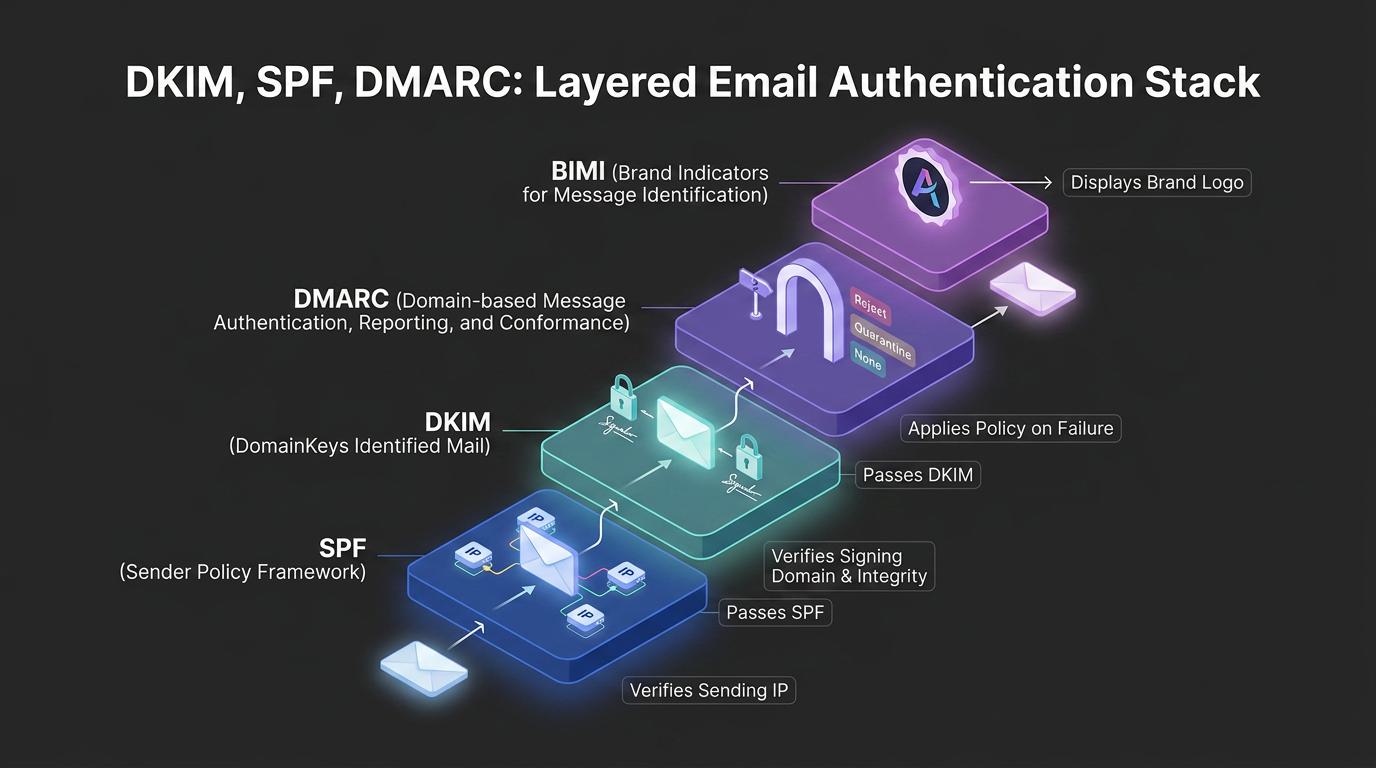
DKIM works with SPF, DMARC, and BIMI by contributing one part of a broader authentication chain that verifies senders, applies policy, and can support brand display.
DKIM is one of three standard email authentication protocols, and each operates at a different layer. Together with SPF and DMARC, DKIM forms the authentication foundation that protects against email spoofing and phishing while improving deliverability for legitimate senders.
- DKIM: Uses cryptographic signatures to prove the signing domain's identity and confirm message integrity.
- SPF: Verifies that the sending server's IP address is authorized by the domain owner to send on its behalf.
- DMARC: Ties the results of SPF and DKIM to the visible From address and tells receiving servers what to do when authentication fails.
Why DKIM Survives Forwarding Better Than SPF
DKIM signatures travel with the message because they are embedded in the email headers. As long as the content remains unmodified, the signature stays valid regardless of how many servers relay the message. SPF validates the sending server's IP address against the domain's authorized list. When an email is forwarded, the forwarding server's IP is typically not in the original domain's SPF record, so SPF fails.
This difference has practical consequences. If an organization relies on SPF alone and an employee forwards email through a university alumni account or a personal address, the forwarded message will fail authentication. With DKIM in place, the original signature remains intact and can still satisfy DMARC. The message can keep its authenticated status even through multiple relay hops. Mailing lists present a harder challenge: list software often modifies subject lines or appends footer text, which breaks the DKIM signature. Authenticated Received Chain (ARC) is the standards-track protocol designed to preserve authentication results through these intermediaries.
How DKIM Alignment Connects to DMARC Policy
DMARC introduces identifier alignment that goes beyond simply checking whether DKIM passed. For DMARC to pass on the strength of DKIM, the domain named in the DKIM signature must align with the domain in the visible From header. Alignment can be strict or relaxed, which allows subdomains to align with the parent domain as defined in RFC 7489. For example, a signature from a mail subdomain aligns with a From address at the parent domain under relaxed mode.
When DMARC fails, the domain owner's published policy determines the outcome. A "none" policy delivers the message and logs the failure. A "quarantine" policy routes it to the spam or junk folder. Under RFC 7489, a "reject" policy instructs the receiving server to refuse delivery entirely. Without DMARC, organizations cannot instruct receiving servers on how to handle authentication failures.
How BIMI Rewards Full Authentication
Brand Indicators for Message Identification (BIMI) adds a visible incentive for organizations that complete the full authentication stack. BIMI allows a domain owner's brand logo to appear next to authenticated messages in supporting email clients. For BIMI to work, the sending domain must pass DMARC at enforcement level, publish a BIMI DNS record, and hold a Verified Mark Certificate from a trusted certificate authority. The progression runs from SPF and DKIM through DMARC enforcement to BIMI brand recognition.
Common DKIM Cybersecurity Mistakes and Known Limitations
Common DKIM cybersecurity mistakes and limitations usually involve weak key management, signature-breaking message changes, and protocol gaps such as replay risk.
DKIM's design still depends on careful configuration, and the protocol itself has documented limitations that organizations need to understand. Many of these issues silently undermine protection without generating obvious errors.
Using Weak Key Lengths or Skipping Key Rotation
The most common vulnerability is weak cryptographic keys. Federal guidance recommends strong RSA keys for DKIM signatures and discourages anything shorter as a long-term option.
Key rotation matters because DKIM public keys sit in DNS where anyone can access them, and long-lived keys give attackers an extended window for offline cracking. Rotating keys on a defined cycle limits that exposure. Each third-party service that sends email on behalf of a domain should also have its own unique key and selector, so revoking one does not disrupt others.
Leaving Messages Vulnerable to Replay and Header Injection
DKIM has a documented weakness around replay attacks, identified in RFC 6376's own security considerations. Because DKIM is non-path-based, a legitimately signed message can be re-sent to different recipients, and the signature remains valid.
Header injection attacks present a related risk. Without over-signing, an attacker can prepend a spoofed header to a signed message. Many email clients display the first instance of a header while verifiers check the second, signed instance. Over-signing critical headers is the primary defense against header injection. The signature expiration tag limits how long a signature remains valid and helps defend against replay attacks.
Breaking Signatures Through Canonicalization and Forwarding
Canonicalization controls how strictly the signature validation process treats formatting differences. The simple mode treats formatting strictly, so even minor whitespace changes from intermediate servers cause verification failures. Using the relaxed canonicalization mode for both headers and body as the default tolerates these common transit modifications and reduces false verification failures under RFC 6376.
Mailing list software poses a particular challenge because it routinely modifies message content by adding subject-line prefixes, inserting footers, or rewriting headers. These changes invalidate both simple and relaxed DKIM signatures. Organizations should audit their mailing list flows before setting a DMARC policy to reject, and consider deploying ARC to preserve authentication results through list intermediaries.
DNS misconfigurations also go undetected frequently. Duplicated tags, incorrect version fields, missing semicolons, and improperly encoded public keys all cause silent DKIM failures. Organizations should verify every new or modified DKIM DNS record after publication by performing a DNS TXT lookup on the selector and domain, then confirming that the returned record contains a valid public key.
DKIM and Compliance: NIST, CISA, and Bulk Sender Requirements
DKIM and compliance intersect because major guidance increasingly treats email authentication as a baseline control.
DKIM has moved from a recommended best practice to a baseline requirement across multiple frameworks. CISA's CPG 2.0 recommends SPF, DKIM, and DMARC set to reject for organizations across all sectors. NIST SP 800-177 Rev. 1 specifies that DKIM keys should use RSA with SHA-256, that each sending mail server should have its own unique private key and selector, and that keys should be rotated on a defined cycle.
For organizations that depend on email reaching their customers, partners, or employees, DKIM deployment directly affects whether messages are more likely to be accepted, quarantined, or rejected by receiving systems that evaluate authentication results.
Building Trust One Signature at a Time
DKIM gives outgoing email a verifiable proof of origin that travels with the message from sender to recipient. When paired with SPF and DMARC, it forms an authentication layer that helps separate legitimate communication from spoofed attacks. Organizations that treat DKIM as a living system by rotating keys, monitoring authentication reports, and auditing third-party senders build the kind of email trust that both human recipients and automated systems recognize.
Frequently Asked Questions
Does DKIM Encrypt Email Content?
DKIM authenticates signed messages and checks whether content changed after signing. Content confidentiality requires separate end-to-end encryption protocols like S/MIME or PGP, which operate independently of DKIM.
What Is the Difference Between DKIM and SPF?
DKIM uses cryptographic signatures tied to the signing domain, while SPF validates the sending server's IP address against a list of authorized IPs published in DNS. DKIM signatures travel with the message and survive forwarding. SPF fails whenever a message passes through an unauthorized relay. DKIM also scales better for organizations using multiple third-party email services, since each service can have its own selector and key pair without relying on IP address management.
What Happens if DKIM Verification Fails?
The outcome depends on the domain's DMARC policy. If DMARC is set to none, the message is delivered normally and the failure is logged. A quarantine policy routes the message to the recipient's spam folder. A reject policy instructs the receiving server to refuse delivery entirely. Without a DMARC policy in place, the receiving server makes its own judgment based on local spam filtering rules, which varies widely across providers.
Is DKIM Required for DMARC to Work?
DMARC can technically pass on SPF alignment alone. Relying only on SPF creates a significant gap: any forwarded email will fail SPF because the forwarding server's IP is not in the original domain's authorized list. With DKIM in place, forwarded messages can still pass DMARC through DKIM alignment. The combination of both protocols is far more resilient than either one alone.
What Key Length Should I Use for DKIM?
Strong RSA keys are the recommended minimum under current federal guidance. Security standards require RSA with SHA-256 for government use and consider the older SHA-1 algorithm unapproved. Organizations looking for shorter keys with equivalent security can consider Ed25519, which provides strong protection under RFC 8463.
