
NOTE: Demo visuals include blurred data or synthetic placeholders to protect customer privacy.
The Scattered-Context Problem
Every agent that reads Abnormal's internal knowledge pulls from the same sprawl of systems, and every one of them trips over the same contradictions. Andy called out meeting prep bots, follow-up bots, the question bot he used to own, and the help site chatbot he is building now. All of them need context. All of them have to decide which source to trust.
- Source freshness varies by system. Confluence goes stale, Drive is usually more current, and Slack updates the moment someone spots a bug.
- A single roadmap question can return five docs saying a feature ships next quarter, one Slack message from a PM saying it slipped, and a GitHub PR history showing the code already merged.
- Agents land in the 80 to 90 percent accuracy range on their own, but the last gap is exactly where conflicting sources hurt most, and no amount of prompt tuning closes it.
Reverse-Engineering the Company
Andy's solution was to stop asking agents to reconcile sources at query time and build a reconciled substrate once. He released a swarm of AI agents across Confluence, Google Drive, Slack, Jira, Salesforce support cases, and GitHub PR history, and told them to reverse-engineer how the company actually works. The output comprises over 1,000 cross-referenced Markdown files covering the GTM and product engineering sides of the house.
This layer produces:
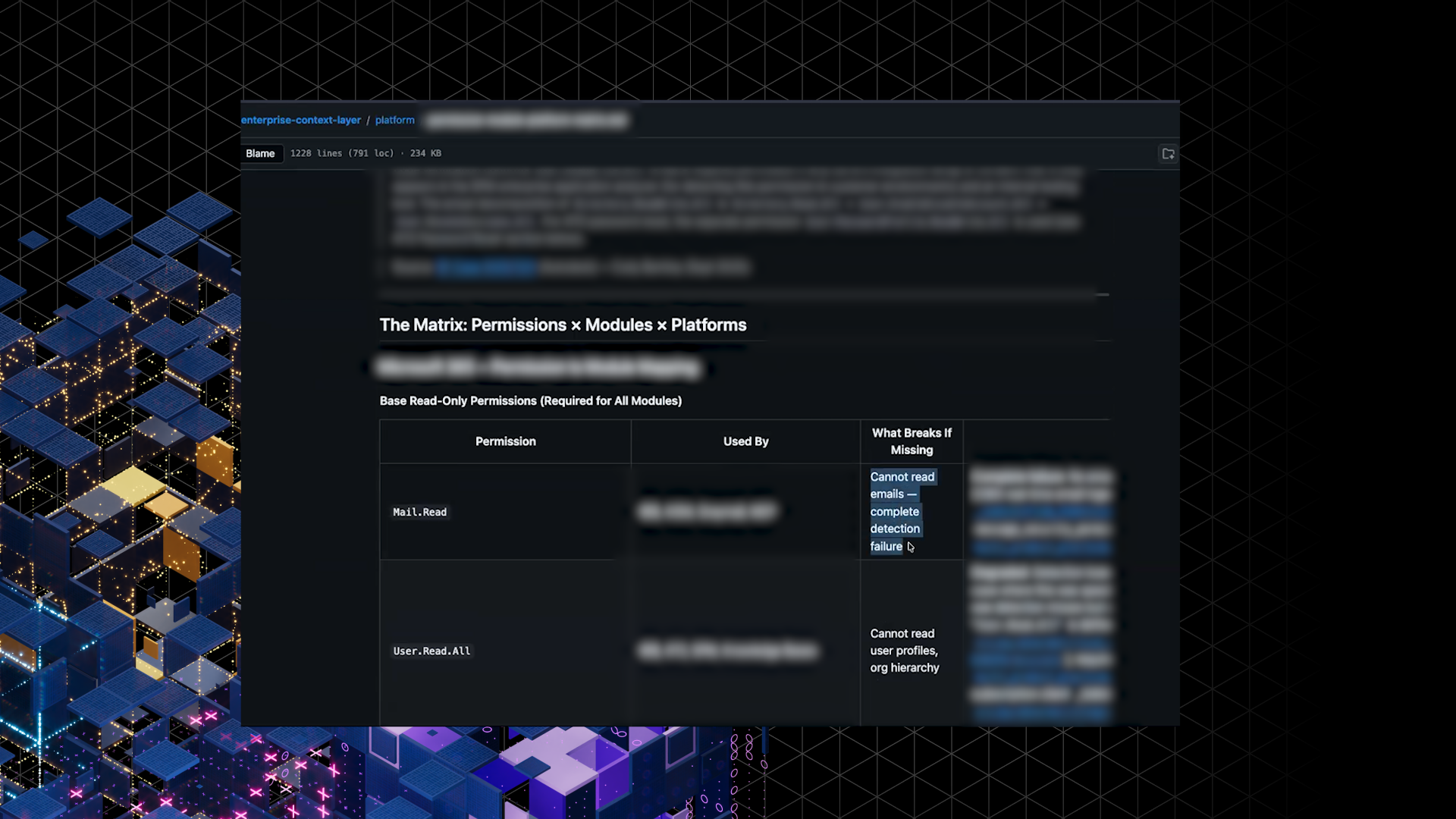
- Documents that did not previously exist in any single place, including a permissions-by-module-by-platform matrix, a GovCloud and FedRAMP feature-parity map, and a 1,300-line Proofpoint battle card
- Validation by the people who would know: Sarah on the technical writing team confirmed the permissions matrix, and Claire in competitive intel confirmed the Proofpoint doc
- A single substrate that any downstream agent can read from without reinventing context plumbing
Once the layer exists, building a new internal agent stops being a context-wrangling project and starts looking more like a prompting exercise.
Downstream Agents Get Sharper
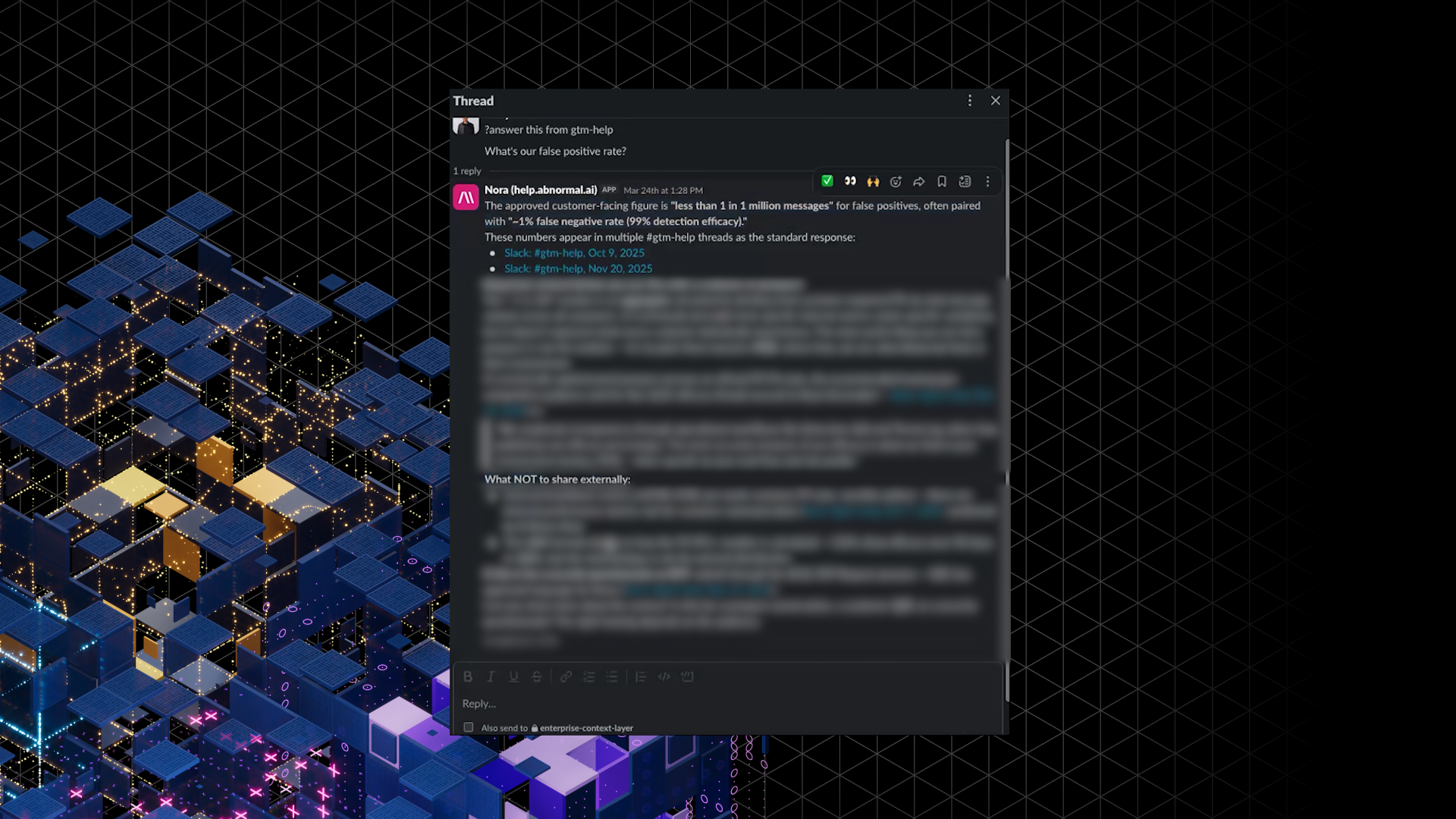
The clearest proof point this week was a GTM Help agent. GTM Help is the internal channel where reps ask and relay questions that span compliance, security, pricing, and product. It has historically been hard to automate because generic bots return confident answers on questions that actually need caveats. Andy did not hard-code anything GTM-specific. He told the agent to answer as if it were posting to GTM Help, and the context layer handled the rest.
For reps working in GTM Help, answers now arrive with built-in guardrails. A roadmap question comes back with instructions to check for an NDA before sharing anything specific, or to book time with a PM. A question on EU data residency, historically answered with a confident "does not leave the EU," now returns the honest answer: the safest route is Smita's security and compliance team, because the guarantee cannot be made blindly. Smita confirmed that framing.
For R&D and compliance leaders, the agent stops pushing every edge case up to them and routes only what truly needs a human. On account takeover parity, the bot tells the rep what the external talking point is and separately notes where the real capability is weaker, so reps go into customer calls informed rather than blind.
Impact highlights from the rollout so far:
- Answers distinguish what to share externally from what to keep internal
- Contested questions route to the right team instead of generating a confident guess
- Reps see internal caveats on competitive claims before they hit a customer call
- No GTM-specific logic required. Point a new agent at the layer and it adapts to the channel.
Next step: extend the pattern from GTM Help to the customer-facing help.abnormal.ai chatbot Andy is already building.
Pressure-Tested by Knowledgeable Peers
The validation loop on this project has been telling. One of Andy's peers challenged him to produce a unified permissions document, and the layer already had one. A peer confirmed it was current. Other peers vetted the Proofpoint battle card and signed off on the EU data answer. A peer who runs GTM Help day to day is the heaviest early user of the agent, and when another peer asked about testimonials, Andy pointed straight to her.
The pattern underneath is worth naming. Subject-matter experts are shifting from sole authors of scattered docs to validators of an AI-assembled knowledge base. That is a different job, and it scales differently. Extending the layer from internal reps to customers through help.abnormal.ai is the next test of whether the approach holds up outside a friendly audience. It fits the AI-native posture at Abnormal: treat the company's own knowledge as something AI reverse-engineers and maintains, not something humans tend by hand.
