
NOTE: Demo visuals use either blurred real data or synthetic placeholders to protect customer privacy.
Customer Questions Delay Follow-ups
In every customer meeting, questions about features, pilots, and roadmaps surface. CSMs juggle these alongside back-to-back calls and delayed transcripts. The information they need is scattered across tools or outdated by the following product update.
Three core frictions drove this next version:
- Repetitive questions: Product and roadmap queries are repeated across meetings, but require manual responses each time.
- Information silos: Answers live across Slack, Confluence, and product docs, slowing response time.
- Post-call delay: CSMs wait hours for transcripts before they can draft accurate follow-ups.
These delays make it easy to miss customer details or send incomplete updates. The need was clear: merge transcript automation with live product intelligence.
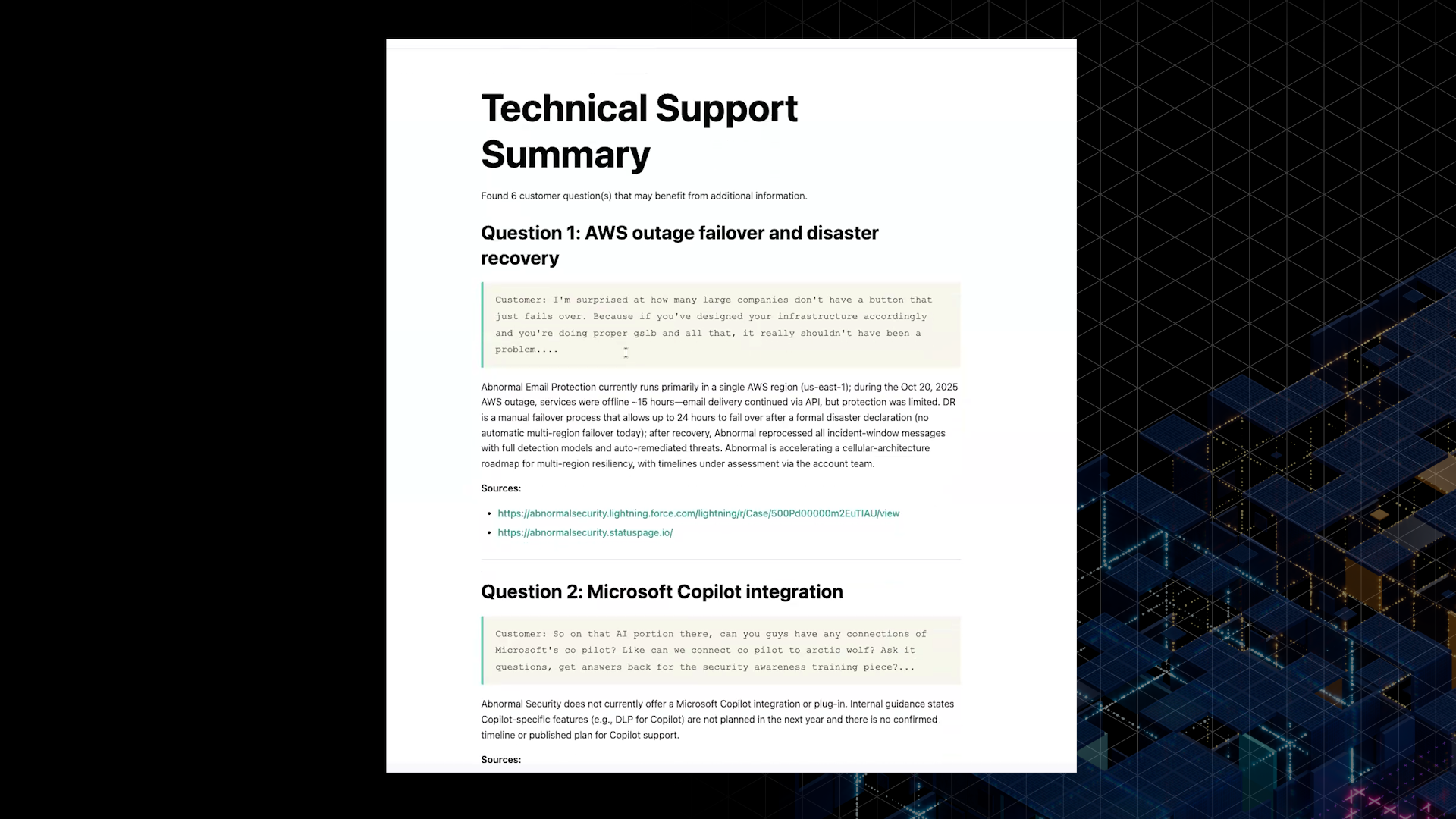
Integrating Question Bot with Gong
Tim’s new integration connects Gong transcripts to the Question Bot’s retrieval system. As soon as a transcript is ready, the tool scans for customer questions, rewrites them into clear queries, and fetches verified answers. It then adds those answers—with links to supporting documentation—into the automated follow-up email sent to the CSM.
Key capabilities include:
- Detecting customer questions automatically from meeting transcripts.
- Translating each question into structured queries for the Question Bot.
- Returning concise, verified answers with links to official docs.
- Bundling responses directly into the CSM’s follow-up draft.
- Operating within minutes of transcript upload.
Tim described it: “We take a Gong transcript, identify the questions a customer asked, translate them for the Question Bot, and provide answers to the CSM in real time.” Implementation was quick since it reused the same follow-up infrastructure and Gong triggers already in place.
Faster Insight, Less Manual Work
The V2 update means customers get accurate answers faster, and CSMs skip the time-consuming search for the latest product details. It keeps the tone consistent while reducing the lag between meeting and response.
Early gains include:
- Time savings: Eliminates manual lookup for repeated product questions.
- Accuracy: Ensures customers get verified, up-to-date information.
- Speed: Draft follow-ups with answers ready within minutes of call completion.
- Reuse: Builds on proven AI GTM components to deliver new functionality fast.
The team plans to test the integration with two to three pilot users, collect feedback on clarity and accuracy, and then refine how product Q&A blends with standard follow-up items.
From Idea to Pilot in Days
Early reviewers highlighted the speed and composability of the update. By reusing shared AI components, the team went from idea to functioning prototype in days, not weeks.
This project reflects a cultural shift at Abnormal: small teams building quickly on standard AI foundations. The next step is piloting with CSMs to tune the Q&A experience and decide whether to merge the two follow-up modes or keep them separate. Either way, the outcome is the same: faster, smarter, more consistent customer communication.
