Key Insights
Cybersecurity for healthcare carries stakes other industries do not face. When hospital systems go down, patients face delayed diagnoses, medication errors, and disrupted care. The FBI's Internet Crime Complaint Center (IC3) named Healthcare and Public Health among the critical infrastructure sectors most affected by ransomware in its 2025 annual report.
Healthcare cybersecurity now depends on protecting trusted communication without disrupting care. But email remains a primary entry point for attacks that exploit trusted relationships. Healthcare leaders therefore need contextual email defenses that reduce risk while supporting patient safety and operational continuity.
This guide examines why healthcare draws outsized attacker attention, where traditional email controls fall short against business email compromise (BEC) and vendor impersonation, and how behavioral AI closes that gap without adding friction to clinical workflows. The takeaway shapes how security teams protect patient data, sustain care delivery, and meet evolving HIPAA expectations.
Key Takeaways
Cyberattacks can reach patient care directly by delaying results, procedures, and treatment decisions.
Phishing, business email compromise (BEC), and vendor impersonation exploit trusted relationships and often lack familiar technical indicators.
Vendors, business associates, and non-hospital providers can expose protected health information and trusted communication channels.
Behavioral AI helps surface impersonation and out-of-pattern requests that may pass standard authentication checks.
Healthcare email security should minimize operational friction and keep alert volume manageable for clinical teams.
The Role of Cybersecurity for Healthcare
Cybersecurity for healthcare protects patient safety by securing the systems criminals target for disruption and data theft. It covers the strategies, technologies, and processes that protect electronic protected health information (ePHI), medical systems, and care operations from cyber threats.
The consequences reach patients directly. A June 2024 ransomware attack on Synnovis delayed blood test results at King's College Hospital NHS Foundation Trust, and the hospital's patient safety investigation later identified the attack as a contributing factor in a patient's death. Peer-reviewed findings in the patient mortality analysis showed in-hospital mortality 34 to 38% higher among patients admitted as a ransomware attack begins.
Healthcare cybersecurity differs from other industries in several important ways:
Care Continuity Requirements: Hospitals operate continuously with life-or-death time constraints. When healthcare IT systems become unavailable, clinicians lose access to safety information about medications, allergies, and clinical decision support.
Interconnected Care Networks: A breach at one business associate can cascade across regional healthcare systems. The Synnovis attack, for example, disrupted pathology services across southeast London hospitals.
Long-Term Patient Trust: Patients affected by breaches may delay care, withhold sensitive information, or avoid treatment altogether.
These pressures make system availability, trusted communication, and patient confidence central parts of healthcare cybersecurity. They also raise the importance of phishing attack techniques and BEC attack techniques in security planning.
Why Healthcare Is a Prime Target for Cyberattacks
Criminals target healthcare organizations because patient records contain identity data that stays exploitable for life. Several characteristics increase the value and exposure of healthcare information:
Persistent Identity Data: A single patient record may include Social Security numbers, dates of birth, addresses, insurance information, and medical history.
Multiple Fraud Uses: Unlike credit card numbers that victims can cancel, this information remains useful for identity theft, insurance fraud, and extortion for years. Criminals can combine health and identity data to support multiple forms of abuse beyond a single fraudulent transaction.
Infrastructure Exposure: Electronic health record systems, Internet of Medical Things (IoMT) devices, cloud billing and telehealth applications, and remote monitoring networks create multiple entry points for attackers.
Most of this infrastructure sits behind the same inboxes and credentials that phishing attack techniques and BEC attack techniques target. This connection makes email protection a central part of the broader healthcare security strategy.
Why Cybersecurity for Healthcare Must Address Email
Email remains one of the most common attack vectors for healthcare organizations because it gives criminals direct access to employees, executives, finance teams, and trusted partners. Social engineering campaigns use phishing and pretexting to obtain credentials or persuade recipients to approve harmful requests.
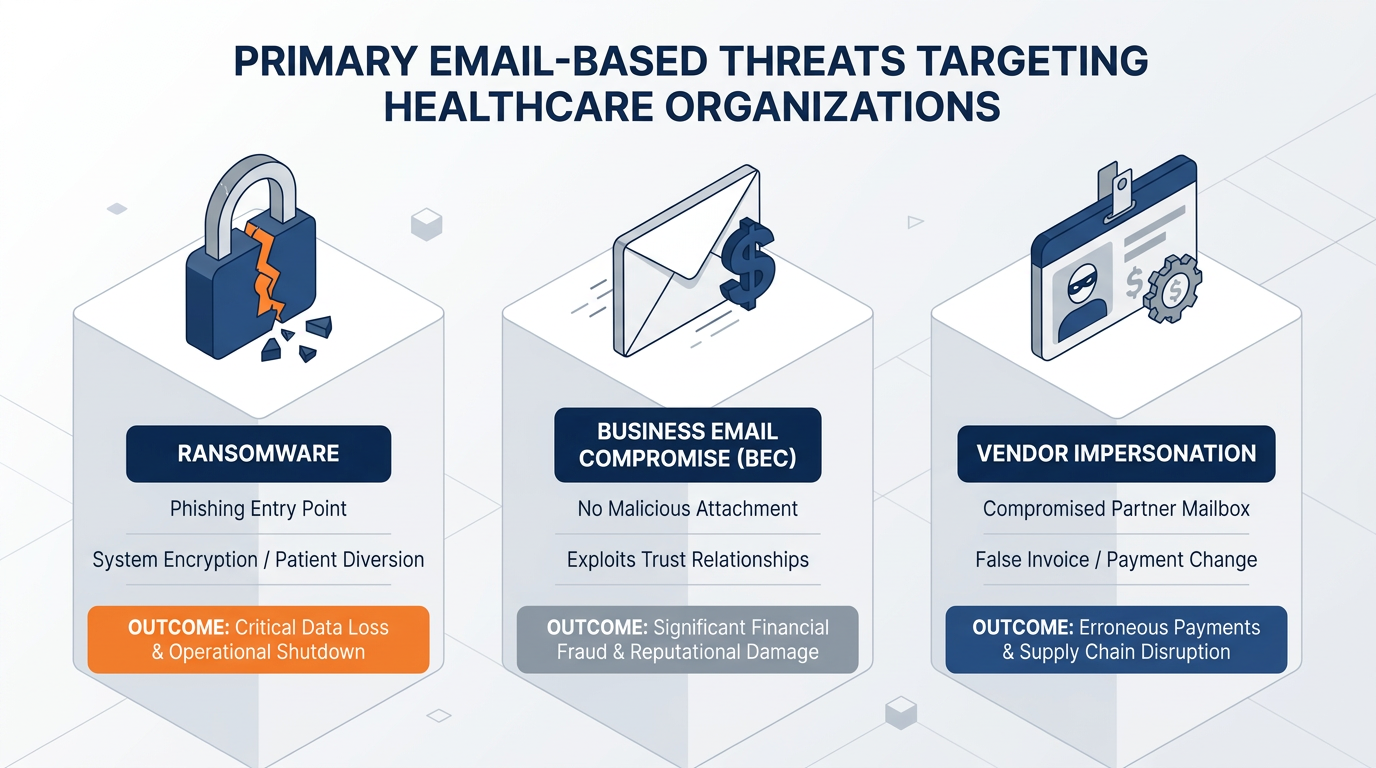
Healthcare organizations face several interconnected email threats:
Ransomware: Phishing and stolen credentials remain common entry points for the system intrusions that precede encryption, patient diversions, and delayed procedures.
Business Email Compromise: BEC attack techniques exploit trust relationships rather than technical vulnerabilities, often using real email infrastructure and clean text content. A wire transfer request from a finance executive's account may carry no artifact for a scanner to evaluate.
Vendor Impersonation: Healthcare's partner networks give attackers cover. A false invoice or payment-change request from a compromised partner mailbox arrives with an existing business relationship behind it.
These threats connect email access to financial fraud, credential theft, operational disruption, and broader system compromise.
Traditional Healthcare Security Misses Behavioral Attacks
The traditional secure email gateway (SEG), along with firewalls and endpoint protection, often struggles to identify BEC and credential impersonation attacks. These controls face several technical limitations:
Artifact Dependence: These tools commonly rely on signature-based detection methods, malware signatures, malicious URLs, or suspicious file indicators to classify a message as a threat.
Clean-Text Attacks: BEC often lacks those artifacts. An attacker impersonating a CFO can request a wire transfer without including an attachment, suspicious link, or known threat signature. A message from a compromised account at a real vendor may also pass Sender Policy Framework (SPF) and DomainKeys Identified Mail (DKIM) checks.
Relationship Context: A signature-based architecture does not weigh whether a request fits the sender's established relationship with the recipient.
That architectural mismatch can create blind spots in healthcare email environments. The gateway still plays an important role in stopping malware and known phishing kits, while behavioral detection can add context around identity, relationships, and request patterns.
AI-Generated Impersonation Compounds the Problem
AI-generated text makes polished grammar a weak signal for distinguishing legitimate messages from fraudulent ones. Criminals also use account takeover fraud to send messages from legitimate mailboxes rather than relying only on spoofed addresses.
These tactics weaken grammar and domain authentication as standalone signals. Behavioral context gives security teams a way to evaluate well-written impersonation attempts without treating polished language itself as suspicious.
How Behavioral AI Addresses Healthcare's Email Security Gap
Abnormal's behavioral AI helps detect email threats by analyzing communication patterns rather than relying only on malware signatures. The platform connects to Microsoft 365 or Google Workspace through an API integration, with no MX record changes or endpoint agents, and models normal communication through several pattern categories:
Identity Patterns: Identity signals, behavioral signals, and session and device signals help indicate whether a message aligns with the person it claims to represent.
Relationship Mapping: Recipient behavior, workflow cadences, organizational relationships, vendor interaction patterns, and engagement flows provide context around who normally communicates with whom.
Contextual Signals: Writing style, tone, business context, and request types help surface content patterns associated with invoice fraud and other BEC attacks.
Together, these patterns provide a behavioral reference point for evaluating messages that lack known malicious indicators.
When an email deviates from these patterns, behavioral AI can help surface the change. Examples include a finance employee receiving an unexpected wire request or an executive account sending an unusual message outside its normal timing. This approach fits the integrated cloud email security category and works alongside existing controls rather than replacing them.
Detecting Vendor and Business Associate Compromise
The healthcare attack surface increasingly extends through vendors and business associates. The American Hospital Association's third-party risk review attributed over 80% of stolen protected health information (PHI) records to breaches involving third-party vendors, business associates, nonhospital providers, and health plans rather than hospitals.
When attackers compromise a business associate's mailbox, they can write from a legitimate domain with valid authentication. For example, an attacker might compromise a medical device vendor's mailbox and reply inside a legitimate purchase order thread with updated wire instructions. SPF and DKIM could remain valid, the domain could be real, and the message might carry no malicious payload.
Vendor behavioral profiles give the detection model a reference point for several observable email deviations:
Recipient Pattern: The request reaches an unfamiliar recipient outside the vendor's established engagement flow.
Timing Pattern: The message arrives at an unexpected time compared with the vendor's normal cadence.
Thread Pattern: A conversation that has never covered banking changes suddenly introduces new payment instructions.
The model is designed to surface these deviations by focusing on email behavior surrounding the invoice. Finance teams still need separate payment verification controls.
Protecting Healthcare Without Disrupting Care Delivery
Healthcare implementations need to strengthen email security without adding friction to clinical workflows. The platform operates through API-based integration with no MX record changes, endpoint agents, or inline deployment.
Clinical staff may treat security friction as an obstacle when it interrupts care, while burdensome authentication and poorly integrated tools can push employees toward workarounds. Detection therefore works best when it helps security teams address a suspicious message before a nurse, physician, or billing clerk acts on it. Security teams can also remediate confirmed threats to reduce the number that remain in user inboxes.
Alerts that repeatedly flag legitimate messages teach staff to discount future warnings. Learning organization-specific communication patterns instead of applying only generic rules can help keep alert volume manageable. The two scenarios call for different levels of scrutiny:
Routine Payment Request: Matches a vendor's established cadence, recipients, and thread history, and warrants standard handling.
Sudden Banking Change: Arrives through an unfamiliar engagement flow or breaks from the vendor's usual pattern, and warrants priority review.
Distinguishing between the two is what keeps alert volume manageable without dulling the signal that matters.
How to Build a Healthcare Email Security Strategy
Healthcare organizations can layer behavioral email detection onto existing infrastructure without replacing current controls. The following sequence can help security leaders evaluate gaps, establish useful behavioral context, and connect detections to operational response:
Assess Current Detection Gaps: Evaluate whether existing email security tools can flag attacks that contain no malicious links, attachments, or known threat indicators. This assessment can expose blind spots around BEC and vendor impersonation.
Establish Behavioral Patterns: Use the identity, relationship, and contextual categories above to establish organizational reference points. API-based deployment allows the model to learn from historical email without inline changes.
Create Response Workflows: Define escalation procedures for detected impersonation attempts, including criteria for security team review. Automated remediation for confirmed threats can reduce the volume that requires user action.
Measure Effectiveness Appropriately: Track detections involving text-only attacks and vendor compromise attempts, and monitor false positives closely. Security teams should also make detections visible within the wider security operation alongside existing email controls.
Following this sequence helps connect behavioral detection to the organization's current tools, response processes, and care-continuity requirements.
Behavioral detection also complements HIPAA-required controls by addressing human-layer risks that infrastructure controls may miss. In January 2025, the U.S. Department of Health and Human Services (HHS) published a proposed Security Rule update that would, if finalized, make multi-factor authentication (MFA), encryption of ePHI at rest and in transit, annual asset inventories, and annual risk analyses mandatory. The existing Security Rule remains in force, and the Office for Civil Rights continues to enforce it.
Email detection does not replace these safeguards. It adds context for situations in which a trusted, authenticated sender asks an employee to take a harmful action.
Strengthen Healthcare Email Security Without Disrupting Care
Healthcare security leaders should evaluate whether behavioral email detection accounts for identity, relationships, and request context and how it fits within integrated cloud email security without disrupting care or displacing controls that already address known malware, payment verification, and compliance risks.
Abnormal works alongside existing email security controls and was named a Customers' Choice in the 2026 Gartner® Peer Insights™ Voice of the Customer for Email Security, the only email security platform to earn this recognition for three consecutive years. To evaluate how Abnormal's behavioral detection can close gaps in healthcare email security while supporting care continuity, book a demo.
Frequently Asked Questions
What Does Cybersecurity for Healthcare Cover?
Cybersecurity for healthcare protects ePHI, clinical systems, connected medical devices, cloud applications, care operations, and staff email accounts. An effective strategy combines access controls, encryption, asset management, risk analysis, infrastructure and email security, incident response, business continuity planning, and oversight of vendors and business associates.
Why Do Traditional Email Gateways Miss BEC Attacks in Healthcare?
SEGs may miss BEC because these attacks can use plain text, legitimate cloud infrastructure, or compromised accounts without known malicious indicators. Signature-based controls evaluate URLs, attachments, and sending infrastructure, while BEC relies on a trusted identity or a plausible business request that passes SPF and DKIM checks.
How Does Behavioral AI Reduce False Positives for Clinical Staff?
Behavioral AI uses organization-specific communication context to distinguish routine messages from meaningful deviations. Rather than flagging on generic keywords, the model assesses whether an interaction fits the established behavior of the sender, recipient, and relationship, which helps limit unnecessary alerts to clinical and billing teams.
Does Behavioral AI Replace HIPAA Technical Safeguards?
No. MFA, encryption, access controls, asset inventories, risk analysis, and incident response remain foundational. Behavioral email detection serves a complementary role by addressing impersonation and account takeover fraud when a trusted or authenticated account sends a harmful request, an area authentication alone cannot confirm.