Anomaly Detection in Cybersecurity: Methods and Use Cases
Anomaly detection in cybersecurity helps defenders spot unusual activity earlier, when context still matters and response options are broader. According to IBM's 2025 report, the average breach still takes 241 days to identify and contain, which keeps pressure on security teams to recognize suspicious behavior sooner and investigate it with better context.
Key Takeaways
- Anomaly detection identifies threats by modeling normal behavior first and flagging significant deviations, which makes it especially effective against previously unknown attacks that carry no recognizable signature.
- Modern detection systems use multiple methods, including statistical thresholds, machine learning, specification-based detection, and hybrid designs. Each carries specific tradeoffs in accuracy, interpretability, operational overhead, and maintenance.
- Anomaly detection complements signature-based detection; the two function as partners in a layered defense strategy.
- False positives are a structural property of deviation-based detection. Managing them requires analyst feedback loops, contextual modeling, and realistic expectations about what automation can deliver independently.
What Is Anomaly Detection?
Anomaly detection in cybersecurity is the process of comparing observed events against definitions of normal activity to identify significant deviations. NIST SP 800-94 defines it formally as comparing "definitions of what activity is considered normal against observed events to identify significant deviations." In practice, this means building a behavioral profile of users, devices, network traffic, or applications, then flagging activity that falls outside established patterns.
How Anomaly Detection in Cybersecurity Works and Why It Matters
Anomaly detection starts with a model of what "normal" looks like, then measures everything else against that baseline to find meaningful deviations.
Building Baselines and Detecting Deviations
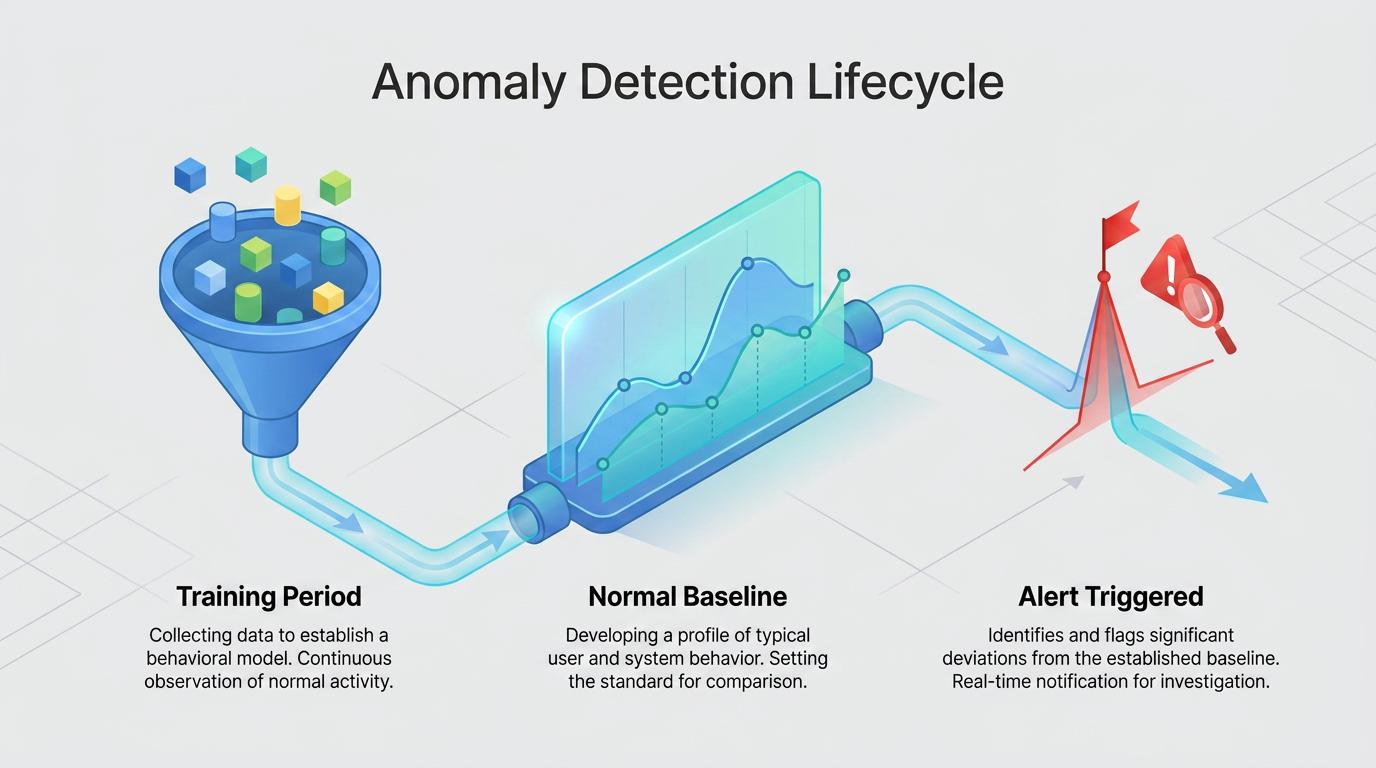
Every anomaly detection system begins with a training period during which it observes and records typical activity. This could include login times and locations for a user, or the volume and cadence of network traffic on a specific port. The resulting profile can be fixed after training or continuously updated as behavior evolves. Continuously updated profiles adapt to legitimate changes, while static profiles offer a fixed reference but require periodic manual updates.
The quality of this baseline determines everything that follows. If training data includes malicious activity, the model may treat that activity as normal going forward. NIST flags the risk of "inadvertently including malicious activity within a profile" during training. Once a baseline exists, the system continuously compares incoming events against it. When activity exceeds a statistical threshold or falls outside a learned cluster of normal behavior, the system generates an alert.
A user who typically logs in from one city during business hours and suddenly authenticates from a different continent at 3 AM would trigger a deviation signal. The same logic applies to network flows, API calls, and other activity patterns. Unlike signature-based detection, which requires a known pattern to match against, anomaly detection flags the unexpected regardless of whether that specific attack has been documented before.
Complementing Signature-Based Detection
Anomaly-based and signature-based detection address different threat categories. Signature-based detection compares observed activity against a list of known attack signatures. Its coverage centers on documented patterns, so zero-day exploits and living-off-the-land (LOTL) techniques, among other novel attacks, fall outside that model when no prior signature exists.
Anomaly detection fills that gap by looking for behavioral deviation. NIST describes this as the "major benefit" of anomaly-based methods: they "can be very effective at detecting previously unknown attacks." CISA's guidance on detecting state-sponsored actors using LOTL tradecraft notes that many organizations lack the established baselines needed to distinguish legitimate behavior from malicious activity.
In production environments, the two approaches work as layers: signatures handle the known threat catalog efficiently, while anomaly detection watches for everything signatures cannot see. Deploying either approach alone leaves a measurable gap in coverage.
Anomaly Detection in Cybersecurity Methods and Techniques
Modern anomaly detection in cybersecurity uses multiple technical approaches suited to different data types and operational constraints across threat scenarios.
Statistical and Specification-Based Methods
Statistical techniques such as thresholds and distribution-based outlier detection flag observations that fall outside expected mathematical ranges. These methods work well for network traffic baselining and volumetric anomaly detection, where sudden spikes or drops carry clear meaning. Their primary advantage is mathematical transparency: an analyst can understand exactly why an alert fired. They struggle, however, with multivariate dependencies and assume relatively stable data distributions, which limits their effectiveness in changing environments.
Specification-based methods take a specification-driven approach by comparing system behavior against formal documentation of how protocols and applications should behave. They derive behavioral expectations from technical specifications. This makes them well suited for OT protocol monitoring in industrial control systems (ICS), including SCADA environments. Building specifications manually requires deep domain knowledge, and attacks that operate within specification boundaries remain invisible.
Machine Learning Approaches
Supervised approaches, including support vector machines and random forests, train classifiers on labeled datasets containing both normal and attack examples. This makes them highly accurate for threats represented in the training data, such as known malware families or documented social engineering patterns. These classifiers depend on labeled attack data; threats outside training set patterns go undetected.
Unsupervised methods identify observations that deviate from cluster structures using unlabeled data. This makes them particularly valuable for discovering novel attack patterns and detecting insider threats, where the specific form of malicious behavior may be unknown in advance. These methods carry a higher false positive rate, since they cannot inherently distinguish between rare-but-benign events and rare-but-malicious ones.
Semi-supervised approaches combine large volumes of unlabeled normal data with a small number of labeled examples. Most enterprise environments record abundant normal activity but have few confirmed attack examples. These methods degrade when the underlying data distribution shifts over time, a problem known as concept drift.
Deep Learning Architectures
Deep learning brings additional power to high-dimensional and sequential data. Autoencoders, trained exclusively on normal data, flag anomalies based on high reconstruction error: if the model struggles to reconstruct an input, that input likely deviates from learned patterns. Recurrent neural networks and long short-term memory models capture sequential dependencies in log data, which makes them effective for detecting slow-moving lateral movement campaigns.
Generative adversarial networks generate synthetic attack data to counteract class imbalance in training sets. A common limitation is interpretability: deep models can produce alerts without clear human-readable reasoning about which features drove the detection.
Most production security environments combine multiple approaches in hybrid or ensemble configurations. A hybrid system might use statistical screening first, then combine clustering and classifiers for pattern discovery and categorization. This layered approach compensates for the weaknesses of any single method, though it introduces architectural complexity around alert fusion and prioritization.
Real-World Anomaly Detection in Cybersecurity Use Cases
Anomaly detection applies across the full attack lifecycle, from initial access through data exfiltration, with specific detection patterns for each stage.
Compromised Accounts and Insider Threats
Business email compromise (BEC) originating from a legitimately compromised account carries no malicious sender signature, which makes behavioral anomaly detection the primary operative layer. Detection signals include email volumes that deviate from a user's baseline and messages sent to recipient domains the account has never contacted. Inbox rule creation, especially forwarding or deletion rules used for persistence, and logins from unusual geographic locations immediately before email activity begins also trigger alerts.
Account takeover follows a similar pattern: once an attacker gains access through credential theft or password spraying, their activity appears technically legitimate. MITRE documents valid accounts abuse through anomalous logon patterns, including abnormal logon types and inconsistent geographic or time-based activity. Insider threats involve authorized users causing harm from within the organization, whether intentionally or through negligence.
Because insiders already have legitimate access, their activity bypasses perimeter-level controls entirely. Anomaly detection surfaces these threats through data access that changes in volume or scope, especially after hours.
Network and Cloud Intrusion
Attackers establishing command-and-control channels often abuse legitimate protocols to blend into normal traffic. Anomaly detection surfaces this through deviations from established baselines: high-frequency DNS queries from unexpected processes, raw TCP socket traffic on ports normally used for standard protocols, or other traffic that departs from normal timing patterns.
Lateral movement presents a similar challenge. SANS documents that ransomware and cyber extortion operators use legitimate Windows tools like PowerShell, Bitsadmin, and PSExec to move through networks. The detection challenge centers on the deviation of their invocation context, process lineage, and destination targets from established baselines. Cloud environments generate massive telemetry from API calls, identity events, and resource configurations.
Anomaly detection monitors for unusual enumeration activity, such as a recently compromised session running bulk resource-discovery commands across cloud providers such as AWS and Azure. Privilege escalation attempts, where function creation coincides with unexpected IAM role assignments, are particularly suited to behavioral detection because no single event in the chain triggers a signature-based alert. CISA's Cloud Security Architecture guidance states that automated tools for monitoring all aspects of the cloud and alerting on anomalies are essential as agencies migrate infrastructure.
Challenges in Anomaly Detection
Anomaly detection systems face structural limitations that affect accuracy, reliability, and long-term operational value.
Anomaly detection systems face structural limitations that affect accuracy and long-term reliability. False positives reflect a core property of deviation-based detection: baselines cannot fully capture legitimate behavioral variation. Over time, a high false positive rate causes alert fatigue, where analysts begin dismissing alerts and create exploitable gaps.
Concept drift compounds the problem. As organizations change, the statistical properties of monitored data shift, and models trained on pre-change data become miscalibrated. Adversarial evasion adds a deliberately hostile dimension: attackers aware of anomaly detection can craft activity designed to stay within statistical norms, and more sophisticated adversaries can attempt to poison training data to shift what the model considers normal.
Emerging Trends in Anomaly Detection
Emerging anomaly detection trends center on how behavioral analysis is being folded into newer operational and access-control models.
Two developments are reshaping how anomaly detection systems operate in production environments. Large language models are being applied to log-based anomaly detection, where their ability to interpret event data is being explored alongside more traditional signatures and statistical thresholds.
Zero-trust architectures are increasingly embedding anomaly detection directly into access policy enforcement, where behavioral analytics feed risk-adaptive access decisions in real time.
Building Detection That Adapts
Anomaly detection delivers the most value when baselines, analyst context, and recalibration stay aligned as environments change.
Anomaly detection delivers the most value when it stays grounded in strong baselines, analyst context, and steady recalibration. As environments change and attackers continue blending into legitimate activity, the most resilient programs will be the ones that treat detection as an evolving operational discipline that requires ongoing care after deployment.
Frequently Asked Questions
How does anomaly detection differ from signature-based detection?
Signature-based detection matches observed activity against a database of known attack patterns, performing well for documented threats but missing novel attacks entirely. Anomaly detection models normal behavior and flags deviations, regardless of whether the specific attack type has been seen before. Most security architectures use both: signatures handle the known threat catalog, while anomaly detection watches for the unexpected.
Can anomaly detection work without machine learning?
Yes. Statistical methods like Z-score analysis and specification-based approaches both perform anomaly detection without any machine learning component. Statistical methods flag observations that fall outside mathematical thresholds, while specification-based methods compare behavior against formal protocol documentation. Machine learning adds the ability to model more complex, high-dimensional patterns and remains one of several available approaches.
Why do anomaly detection systems produce false positives?
False positives arise because the system detects statistical deviation instead of intent. Legitimate activities like software deployments, employee travel, or seasonal workload changes can produce patterns that look statistically identical to malicious activity. Reducing false positives requires contextual modeling, continuously updated baselines, and feedback mechanisms that allow analyst decisions to inform future detection.
What is the difference between anomaly detection and UEBA?
Anomaly detection is a method applicable across network traffic, system logs, email behavior, API activity, and other data domains. UEBA is a capability category that applies anomaly detection specifically to user and entity behavior, adding identity context and peer-group risk scoring. UEBA uses anomaly detection as a core mechanism, and the terms describe different scopes.
