
NOTE: Demo visuals use either blurred real data or synthetic placeholders to protect customer privacy.
Reducing Expert Load
Every customer question used to cost time twice: once for GTM reps waiting, and again for engineers and PMs forced to context switch. The AI Question Bot aims to free both sides by providing verified answers directly in Slack with human-level caution.
Teams still faced three persistent issues that blocked adoption:
- outdated documents that confuse otherwise accurate AI models,
- mixed reliability across sources that leads to random or conflicting answers,
- and hesitation to trust the bot as a true subject expert.
The goal is now clear: achieve expert-grade accuracy with minimal oversight, so humans can focus on work that truly requires judgment.
Modular AI for Safer Answers
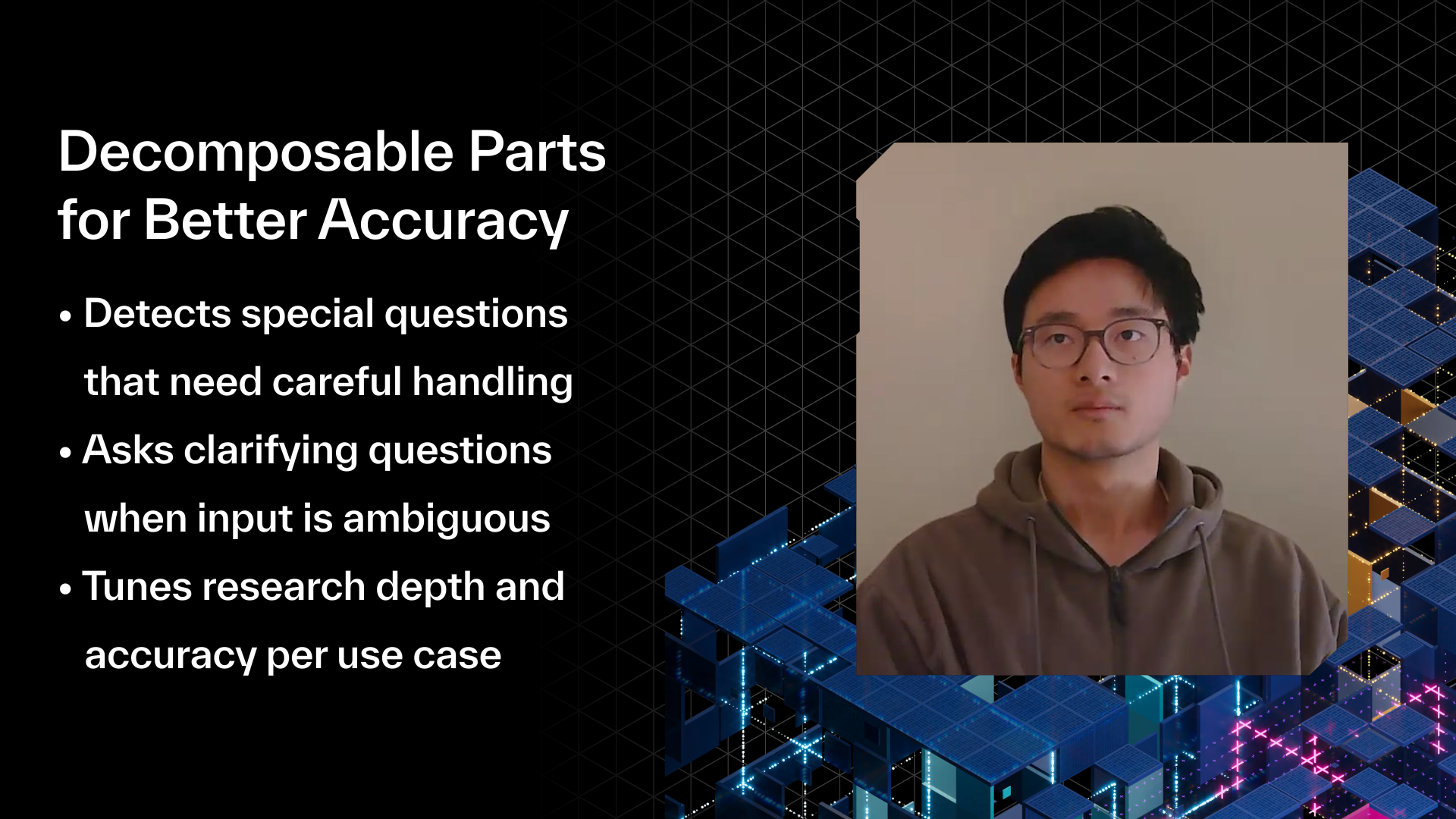
To get there, Andy rebuilt the bot into smaller, decomposable units. Instead of a single monolithic prompt, the system separates key behaviors into modules that can be tested independently and tuned without breaking the others.
These modules work together as follows:
- A special-question detector identifies queries that require careful messaging or policy sensitivity.
- A clarification module asks follow-up questions when input is ambiguous or context is missing.
- A research controller adjusts how deeply the bot investigates before responding.
This structure allows engineers to test each part like software—running unit tests, comparing behavior across product areas, and refining tone where needed. It also makes integrations like the Gong transcript responder or Roadmap bot easier to maintain without retraining the core.
Smarter Messaging and Judgment
The new special-messaging logic ensures the AI distinguishes between purely technical and strategically sensitive questions. For example, when customers ask about internal metrics such as remediation times or dwell times, the bot frames answers with the approved customer context rather than raw numbers.
This awareness now extends into ambiguous cases, too. If a term like “Email Digest” appears in multiple versions, the bot checks and clarifies before committing to an answer. These refinements keep customer interactions aligned with Abnormal’s messaging standards while maintaining technical accuracy.
Impact on Reliability and Testing
By splitting functions, teams can now measure and improve performance faster. Experts can validate separate modules in parallel, tighten the accuracy of sensitive-answer detection, and shorten the loop between feedback and improvement.
The benefits already show up across GTM workflows:
- reduced time waiting for expert validation,
- consistent, tone-safe replies for sensitive topics,
- easier supervision and faster AI testing cycles,
- and confidence that unclear or conflicting inputs will trigger clarification, not hallucination.
Next, the plan is to scale testing across multiple domains and integrate these modules with proactive tools that monitor unanswered questions in real time.
Team Reflections on Precision
Observers noted how modularity turned the AI from a static model into a flexible system—something that can learn, be inspected, and be trusted. Seeing the bot detect policy-sensitive questions and match the phrasing of human experts validated its design.
For Abnormal, this evolution signals maturity. The AI Question Bot is no longer just accurate; it’s responsible, tunable, and built for collaboration between experts and automation.
