
NOTE: Demo visuals use either blurred real data or synthetic placeholders to protect customer privacy.
When Context Becomes the Bottleneck
Different teams stored context in various places: links in comments, spreadsheets in attachments, or one-pagers in Confluence. That inconsistency broke orchestration quality. As Tushar put it, “people have different ways of using Jira... because of which, the context wasn’t built up really good for the LLM.”
The result: Nora’s generated TDDs and tasks were uneven.
Three frictions stood out:
- Context spread across attachments and links, confusing the model.
- Incomplete tech deliverables caused by missing data.
- Slow feedback loops when users thought Nora had stalled mid-process.
Teaching Nora to Read and Reason
The new Jira Orchestrator fixes these gaps by giving Nora analytical autonomy. It now integrates a code interpreter that reads attached files, navigates codebases, and builds a complete technical picture before drafting plans or tasks.
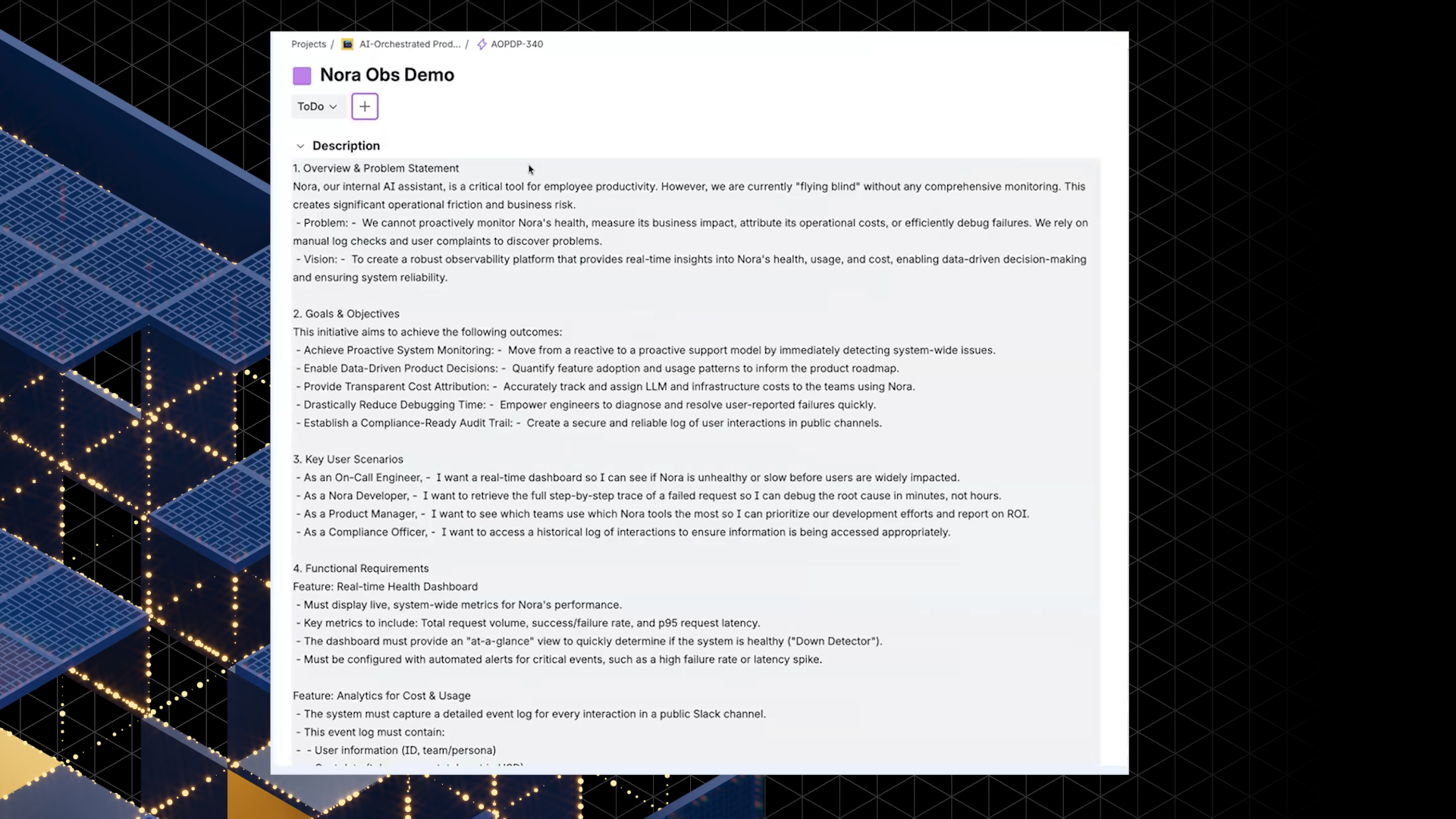
Key upgrades include:
- Attachment analysis: Nora can open and interpret linked docs or spreadsheets within a Jira ticket.
- Code navigation: It scans repositories to identify existing artifacts, dependencies, and gaps.
- Tech plan generation: It writes a detailed implementation plan directly in the epic description.
- Task creation: From that plan, Nora creates tasks sized to user-specified story points.
- User transparency: A new “working” indicator signals when Nora is processing in the background.
“I asked Nora to create a tech plan,” Tushar said, “and it took around 20 minutes to go through the codebase and attached docs, then generated a solid, verbose plan with next steps.”
Smarter Context, Smoother Outcomes
With these upgrades, the orchestrator delivers higher-quality outputs and a more trustworthy user experience. Teams no longer need to standardize how they add context. Nora does that unification itself.
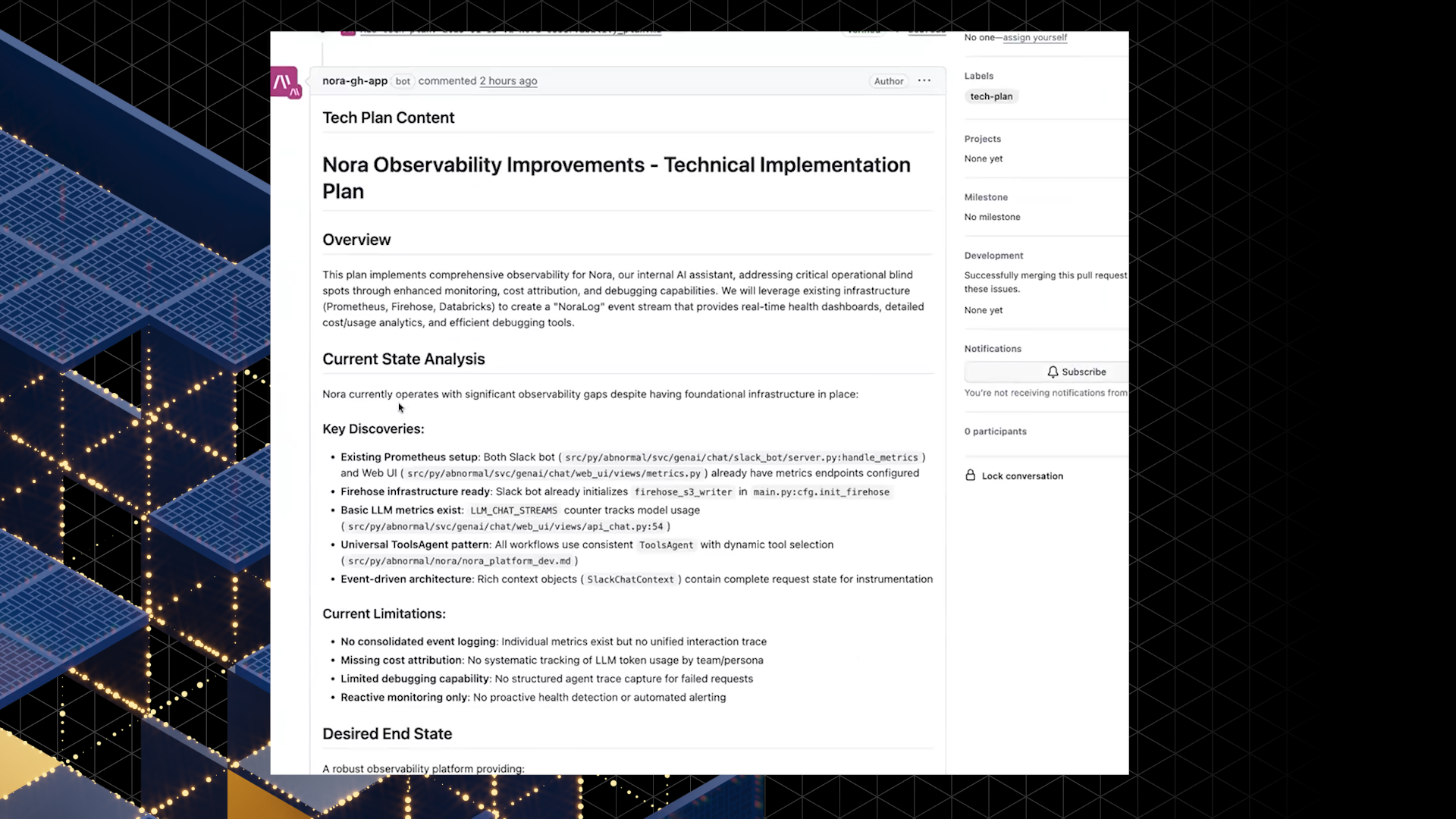
Results so far:
- Consistent deliverables: Every plan reflects a real project state, not assumptions.
- Time saved: Analysis and task generation are automated, cutting manual setup time by hours.
- Confidence restored: The working indicator prevents users from thinking the system froze.
- End-to-end autonomy: Nora can move from epic to tech plan to tasks without human translation.
Together, these shifts make Jira orchestration more self-sufficient. AI now understands, plans, and executes with less prompting.
The next frontier is multi-epic reasoning and Git integration, where Nora will map dependencies across projects and track implementation progress directly from version control.
From “Helpful” to “Autonomous”
Early users say the upgrade feels like the moment Jira Orchestrator “grew up.” It no longer just drafts structured templates; it understands them. Teams see fewer follow-ups, cleaner task lists, and more confidence in Nora’s judgment.
Culturally, it reinforces Abnormal's principle of autonomy through context. Every iteration of Tushar’s work makes the AI less of an assistant and more of a reliable project partner—one who truly knows the job it’s orchestrating.
