
NOTE: Demo visuals use either blurred real data or synthetic placeholders to protect customer privacy.
The Recap
Since its launch, Tim Davison’s Customer Success AI Coach has been on a mission to make scalable, personalized coaching possible for every CSM at Abnormal.
- Version 1 automated post-call feedback, providing structured summaries and coaching emails after each Gong meeting.
- Version 2 introduced persistent skill profiles, tracking growth over time.
- Version 3 added quantitative metrics, integrating data like talk-time ratios and question counts to complement qualitative insights.
Now, in this fourth version, the AI Coach enters a new phase: self-improvement. Using Claude Code agents and real CSM feedback, the system can analyze its own effectiveness and adjust its prompts dynamically, making coaching smarter, more personalized, and more responsive than ever.
The New Capabilities
The AI Coach has expanded from its original two test users to fifteen active participants. With broader adoption comes more diverse feedback: junior CSMs tend to value tactical coaching (“What specific step should I take next?”), while senior CSMs prefer soft-skill development (“How could I improve tone or phrasing?”).
Tim built a series of Cloud Code agents that automatically collect and summarize feedback from multiple channels: Google Forms, recorded CSM interviews, and executive input from leaders. These agents analyze the data, score coaching effectiveness, and refine Nora’s prompts accordingly.
The system runs in a closed feedback loop:
- CSMs receive AI-generated coaching.
- Their reactions and survey input are collected.
- Cloud Code agents summarize and evaluate that feedback.
- Nora’s prompts are updated based on the findings.
The next coaching cycle launches with an improved model.
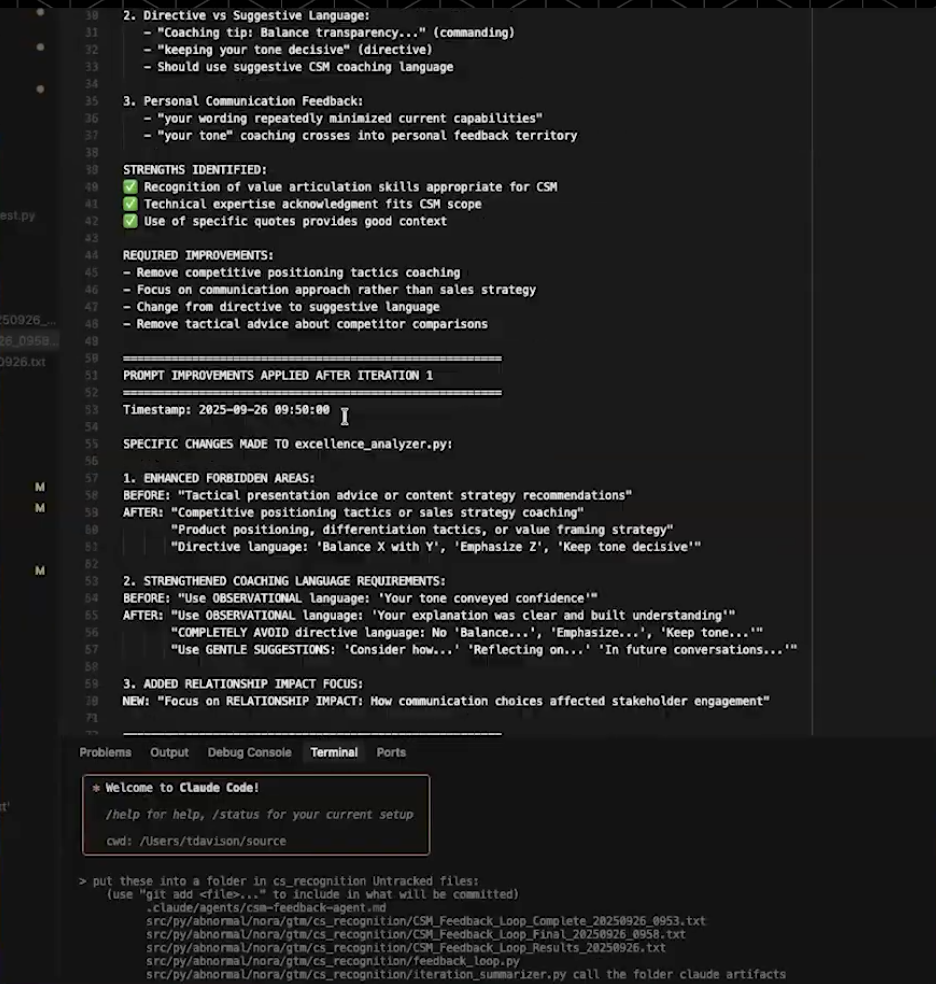
The AI Coach now learns from feedback in real time, rather than relying on manual tuning, raising coaching quality every week.
Analysis of CSM feedback revealed distinct coaching needs:
- Newer CSMs prefer actionable, tactical tips (“partner with your AE for renewal strategy”).
- Experienced CSMs prefer reflective guidance and soft-skill suggestions (“try pausing after asking about ROI to let the customer elaborate”).
The AI Coach now tailors its tone and content accordingly, balancing concrete next steps with empathy-driven communication coaching.
One pilot user acted on a coaching email that flagged a missed opportunity: a customer mentioned interest in Abnormal’s Graymail Pilot, which hadn’t been discussed on the call. After receiving that insight, the CSM followed up, and the team successfully moved forward with the pilot.
The AI Coach is also now capable of evaluating its own performance: for instance, a 6/10 effectiveness rating led to prompt refinements that improved subsequent feedback quality to a 9/10 in testing.
The Impact
With this new self-learning loop, the Customer Success AI Coach has evolved from an automated feedback tool into a continuously adapting coaching engine.
- Smarter over time: Each coaching cycle refines the next, informed by real user sentiment.
- Personalized at scale: Feedback is calibrated to each CSM’s experience and learning style.
- Faster iteration: Prompt improvements happen automatically through Cloud Code, not manual reprogramming.
- Manager relief: Executives can rely on real feedback analytics without conducting manual reviews.
- Higher engagement: CSMs feel heard and their feedback directly shapes how the tool evolves.
In short, the AI Coach is now coaching itself to become better for the humans it serves.
What’s Next
The next phase of the Customer Success AI Coach will continue to expand on its real-time learning foundation:
- Merged feedback and performance data: Combining survey sentiment with Gong metrics to measure how coaching changes CSM behavior over time.
- Dynamic tier calibration: Allowing the AI to automatically detect experience level and adjust coaching type (tactical vs. strategic) without manual tagging.
- Leadership dashboards: Visualizing trends in coaching effectiveness across individuals and teams, complete with AI-driven recommendations.
- Adaptive goal setting: Using AI to suggest personalized development milestones based on performance data and coaching history.
With each iteration, the AI Coach moves closer to true adaptive enablement with a system that doesn’t just provide feedback, but learns, reasons, and evolves alongside the people it supports.
This fourth version of the Customer Success AI Coach marks a defining step forward from scalable coaching to self-optimizing coaching. By integrating real-world feedback, Cloud Code automation, and adaptive prompt tuning, Tim Davison has built a model for how AI tools can evolve through human partnership.
