
NOTE: Demo visuals include blurred data or synthetic placeholders to protect customer privacy.
The Next AI Marketing Wedge
Andres framed AI as the first wedge into a redesigned marketing team. Today AI shows up in pockets, helpful but disconnected. His goal is a single brief that produces a coherent set of artifacts (display ads, email, papers, event assets, articles, landing pages) and a system that can carry that brief from idea to spend to analytics without human stitching in between.
Marketing AI Stays Siloed
Marketing teams use AI today, but each tool sits in its own lane. A copy assistant lives in one tab, image generation in another, the ad platform somewhere else, and the analytics dashboard somewhere else again. The team becomes the integration layer, and that work does not scale.
Andres laid out three frictions the demo is built to remove.
- Separate AI tools produce strong pieces in isolation, but no shared brief brings them together into a single campaign.
- Brand fidelity (Abnormal's green, the Everett font family) is hard-coded into HTML or template components rather than specified within the generation itself.
- Performance data and creative production live apart, so reinvesting in what is working takes manual handoffs and ad agency back-and-forth.
One Loop for the Campaign
Andres connected the pieces. The system takes a brief (for example, an account takeover ad targeting healthcare CISOs), generates a brand-true creative concept, writes the matching post and call to action, and pushes everything into LinkedIn as a draft campaign with a budget bin attached. Stakeholders can ask how campaigns are performing in Slack and receive a campaign breakdown. Connected systems include Nano Banana Pro for image generation, the LinkedIn API for campaign creation and spend, Slack for stakeholder access, and Claude Code for analytics work alongside the agency.
Key capabilities in this release include:
-
Generating brand-true creative directly in Abnormal's green and Everett font, with the brand specified in the generation step rather than enforced by a downstream component.
-
Writing the matching post, headline, intro, and call to action keyed to the target (audience, segment, vertical).
-
Creating the LinkedIn campaign and creative through the API, with a real budget line attached so the AI can allocate spend, not just propose it.
-
Pulling performance back through Slack and Claude Code so the team can read results and decide where to reinvest.
In Andres's words: "we have a line item right now in our budget for, like, AI-generated marketing campaigns."
Closing the seam between creative, paid, and analytics is the point. Once the brief, the assets, and the spend live in one loop, the team stops acting as connective tissue and starts directing the system.
What This Opens Up
The release just launched, so quantified outcomes are still ahead. The frame is qualitative for now: Andres is running a shadow campaign in the market alongside the agency-built SOC automation campaign, with both competing on the same surface, so the AI work has a visible benchmark to beat.
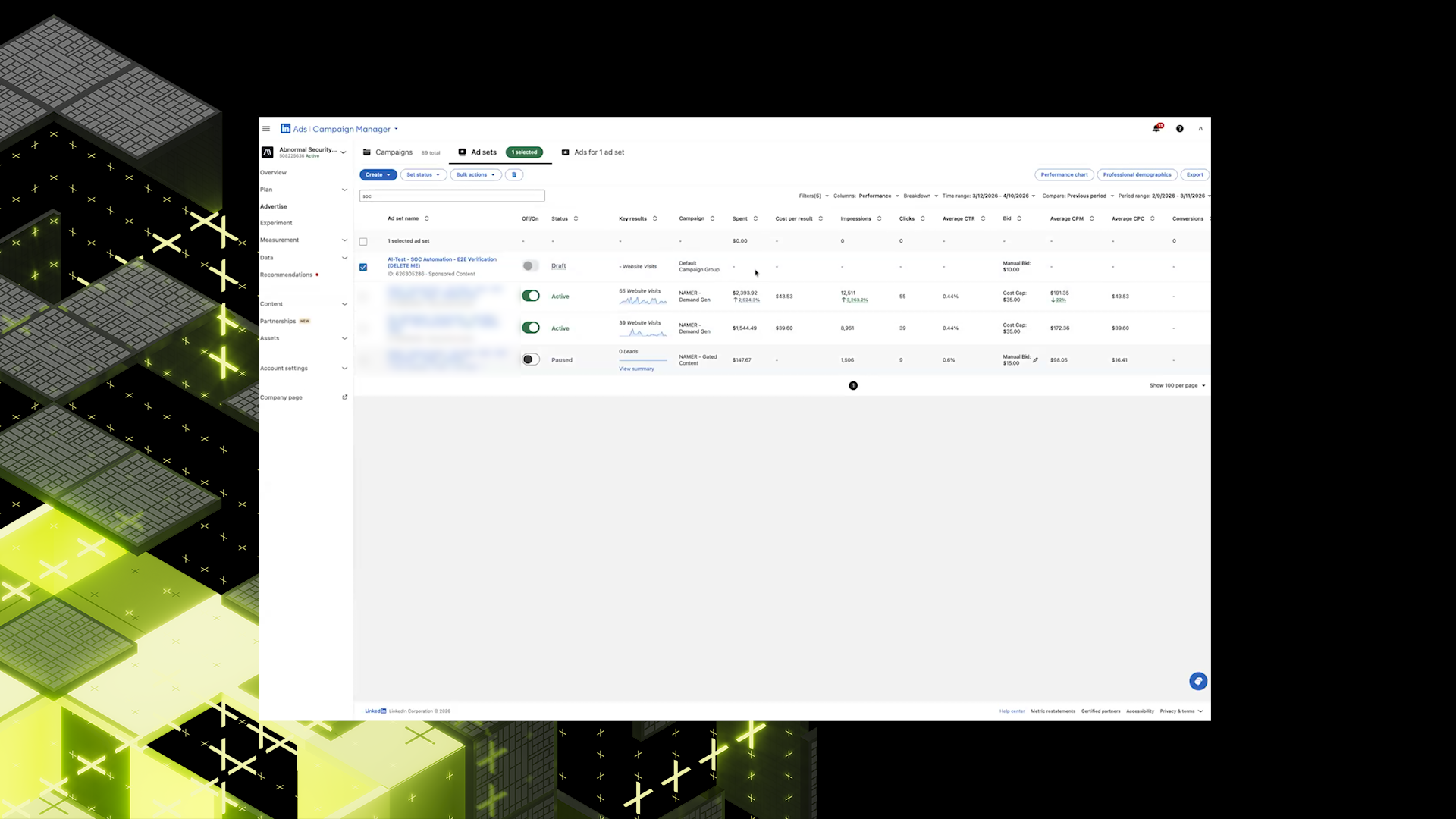
For marketers and operators on the team, the value shows up as less manual stitching across creative tools, ad platforms, and analytics. For leadership, the value is a live, head-to-head comparison between AI-generated and agency-generated work, with real spend behind both, that produces a defensible signal on where AI marketing is actually competitive.
Impact at this stage:
- Frees the team from serving as the integration glue between creative tools, ad platforms, and analytics tools.
- Treats brand assets (color, typography) as parameters of generation rather than as downstream code.
- Sets up a reinvestment strategy: campaigns that perform attract more budget without a manual review cycle for every move.
- Prepares the system to make cross-artifact tradeoffs (display, email, Google Ads) once those surfaces come online.
The next concrete step is moving the experience out of Slack into a streamlined app, working through the open LinkedIn API gaps with the LinkedIn rep, and graduating the shadow campaign out of drafts so the AI can spend live and the loop can close on real performance.
A New Shape for Marketing
The reaction in the room went straight to the new posture this creates. One peer noted that connecting the LinkedIn API is what turns this from creative help into a fully automated marketing motion, the first time the loop has run without a human passing artifacts between tools. The room read this as a real signal, not a sandbox.
Culturally, this is the part of marketing Andres has chosen to pressure-test the AI-native operating model on. Ads are the first wedge, but the pattern (one brief, one loop, AI deciding allocations a marketer would normally make) is the template the rest of the function will follow. It is also a reminder that the most useful AI work at Abnormal is not a side project; it is where production budget and brand voice meet in the same system.
