
One Offer Approval Workflow
After interviews wrap and a candidate is approved, the recruiter has to assemble an offer approval packet for the hiring manager. The information needed is spread across several systems: candidate and job details in Greenhouse, compensation context in tools like Workday and Pave, and interview context in BrightHire.
In practice, the TA team has ended up with multiple GPTs just to get through this single process. That fragmentation creates three recurring issues:
- Time sink: recruiters waste time hunting for details, copying between tools, and formatting.
- Accuracy risk: math done “inside the LLM” can hallucinate, and humans can also introduce errors when porting data manually.
- Workflow instability: with an ATS transition potentially coming (moving away from Greenhouse), there isn’t a clean, durable “source-of-truth” workflow to carry forward.
A Human-Controlled Offer Approval Agent
Jake’s solution is a single agent designed around what the recruiter actually needs at the end: a personalized offer approval email that’s ready for the hiring manager to review and approve. The agent pulls and composes the approval context automatically, but it’s intentionally designed so humans remain in control, especially around compensation math and logic.
At a high level, the flow looks like this:
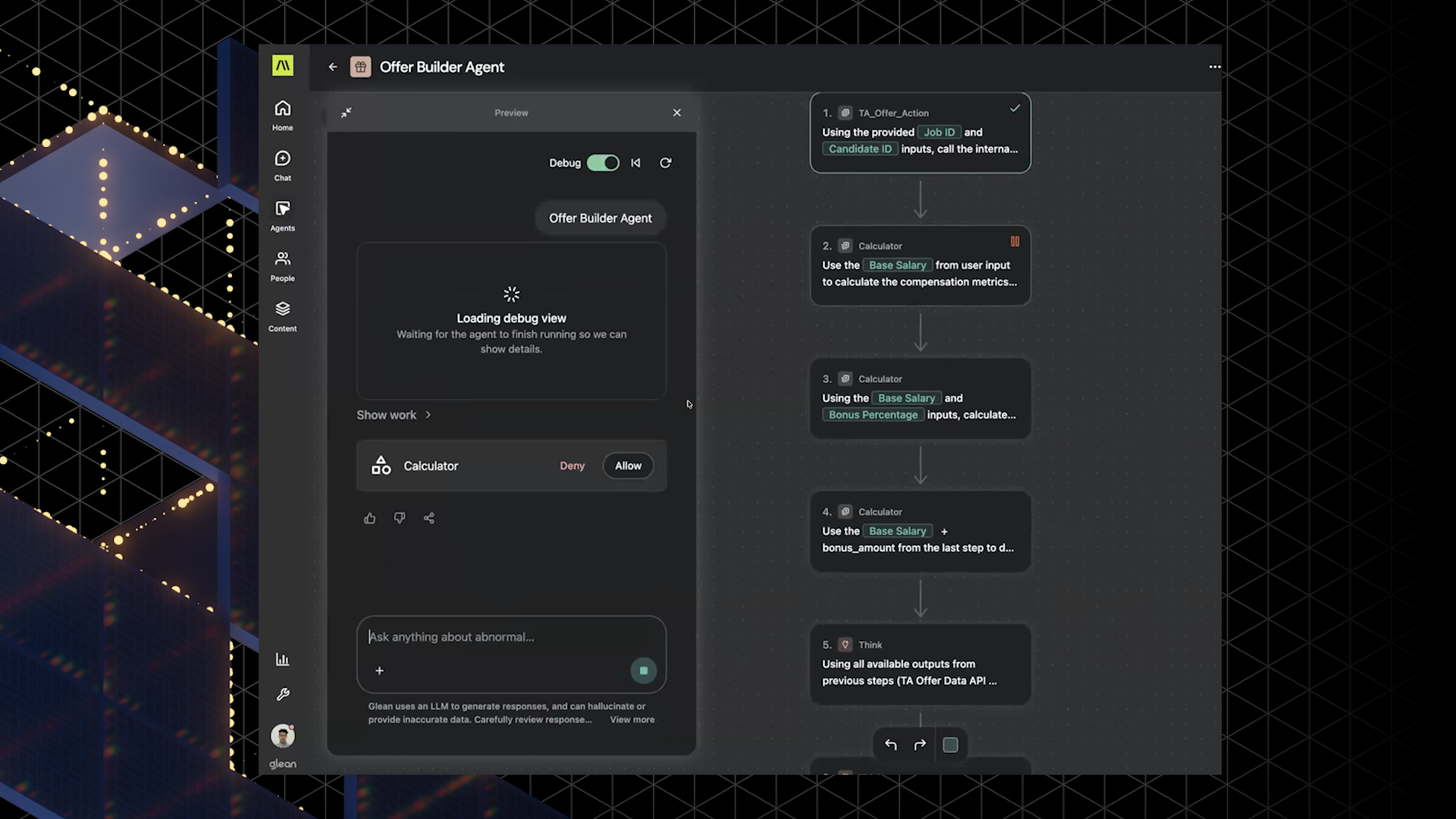
- The recruiter runs the agent using job ID + candidate ID.
- The agent pulls data from Greenhouse and other sources, including BrightHire transcripts (where interview feedback lives).
- It performs structured calculations recruiters need for approvals, such as:
- Compensation ratio (salary ÷ mid-range)
- Bonus calculation (e.g., salary × 15%)
- Total compensation roll-up
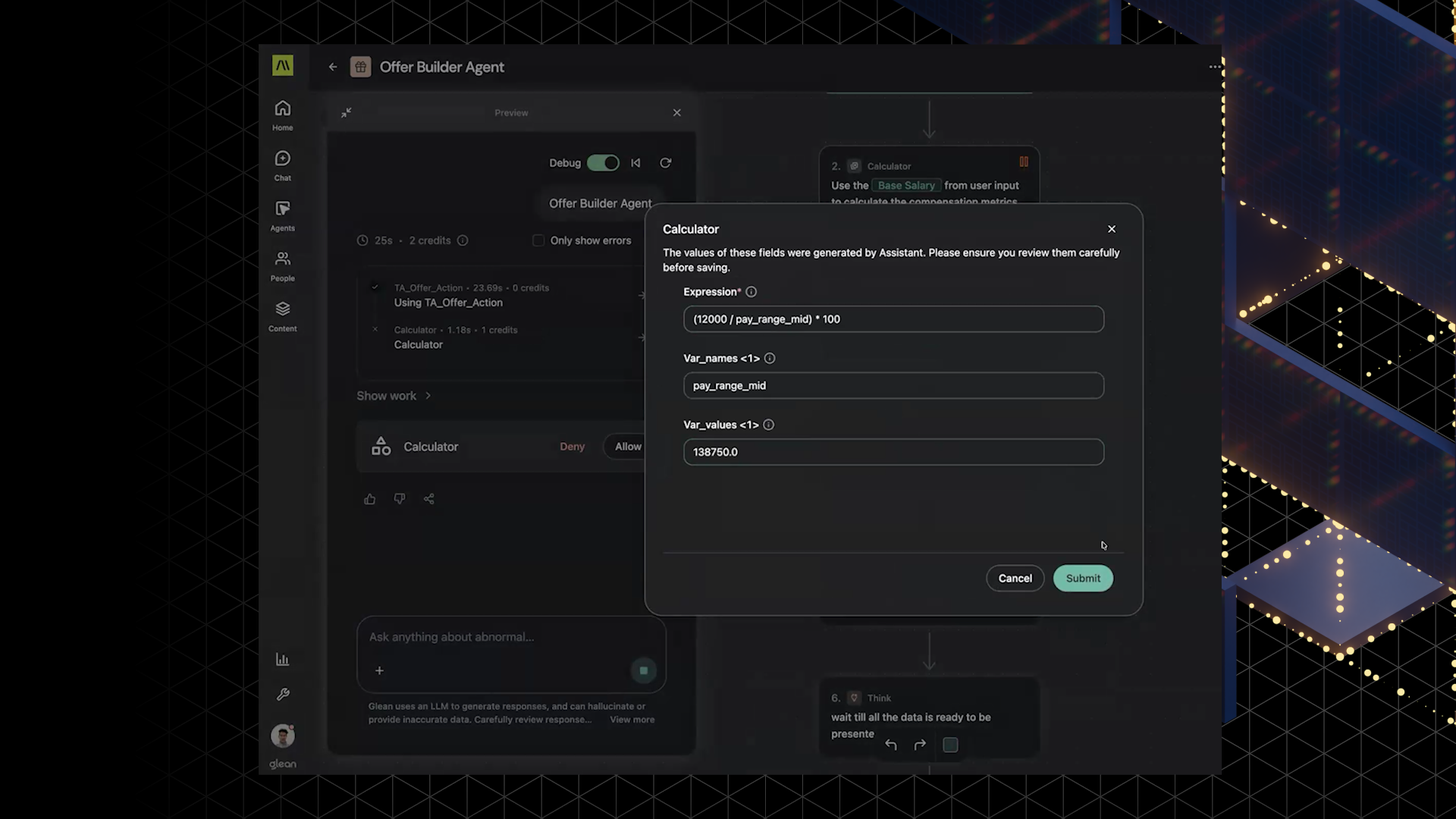
At key points, the agent pauses and asks the recruiter to validate and approve the math, or correct it if something looks off. Once validated, the agent generates the full approval email and drops it into Gmail drafts, ready to send.
Why Human-in-the-Loop Matters
Jake called out something important: offer approvals aren’t just another “summarize this doc” workflow. They involve sensitive compensation data, and the recruiter must be able to trust and verify the output.
So instead of pretending the AI will always get the math right, the workflow makes verification explicit. The recruiter can review intermediate outputs, confirm calculations, and correct issues before anything is finalized. In the demo, Jake even pointed out a moment where the math formatting looked off (an extra zero), and the agent provided a checkpoint where that could be fixed before the email was generated.
This is the difference between “AI drafts something” and “AI runs a controlled process.”
At the end, the recruiter doesn’t get a pile of partial notes across tools. They get a complete approval email in the correct format, automatically created as a Gmail draft. That email synthesizes the candidate’s role and job context, compensation details and the rationale behind them, interview feedback and holistic candidate evaluation (including transcript-based insights), and the structured approval framing the hiring manager needs.
The result is a workflow that feels like a single, repeatable “offer approval product,” not a patchwork of prompts.
Impact So Far
Jake highlighted a few immediate wins:
- **Time saved: **recruiters no longer have to manually source and port information into separate GPTs.
- Workflow consolidation: replaces the “one GPT per department” pattern (GTM vs. SWE vs. AI Eng vs. R&D) with one consistent approval workflow.
- Accuracy up: pulls richer context (like transcripts) and performs structured calculations with validation, rather than relying on LLM guesswork.
- Future-proofing: creates a clear, consistent summarization + consolidation layer that can help TA transition away from Greenhouse if/when the ATS changes.
The agent is already deployed to a subset of the TA team for testing (including Rachel and Kristen). And it’s positioned as the first step on a broader roadmap of TA-focused automations, starting with the most painful, highest-stakes bottleneck: offer approvals.
