
NOTE: Demo visuals use either blurred real data or synthetic placeholders to protect customer privacy.
The Recap
Over multiple demos, Tushar Amrit has been steadily evolving the Jira Orchestrator from an automation tool into a true AI-driven project partner.
- The first version showed how Nora could automate PRD, epic, and task creation, simplifying project setup.
- The second version introduced persona-based orchestration, allowing Nora to tailor workflows for different projects, such as ARN, by referencing past tickets and proactively suggesting follow-up questions.
- Now, with this third major update, the focus shifts to depth of understanding, teaching Nora how to read, analyze, and reason across attached documentation and real codebases to generate richer, more actionable technical outputs.
The goal remains the same: move from AI assistance to AI orchestration. But this new version makes that orchestration far more informed and consistent.
The New Capabilities
This latest version introduces major upgrades that improve context building, autonomy, and user experience.
Nora can now read and analyze attachments and linked files in a Jira ticket, such as spreadsheets, one-pagers, or design docs, independently. It can also navigate the codebase directly, using that context to understand what’s already implemented, where artifacts live, and what’s missing. This eliminates the earlier issue in which users added context inconsistently (comments, attachments, links), which confused the model and reduced output quality.
The orchestrator now builds a complete project context, no matter where users store their information, resulting in stronger, more accurate deliverables. Given an epic (e.g., Nora Observability), Nora scans the attached files and the codebase to produce a comprehensive technical plan.
The plan includes:
- A breakdown of existing code and dependencies.
- A list of expected artifacts and where they exist.
- Gaps and recommended next steps.
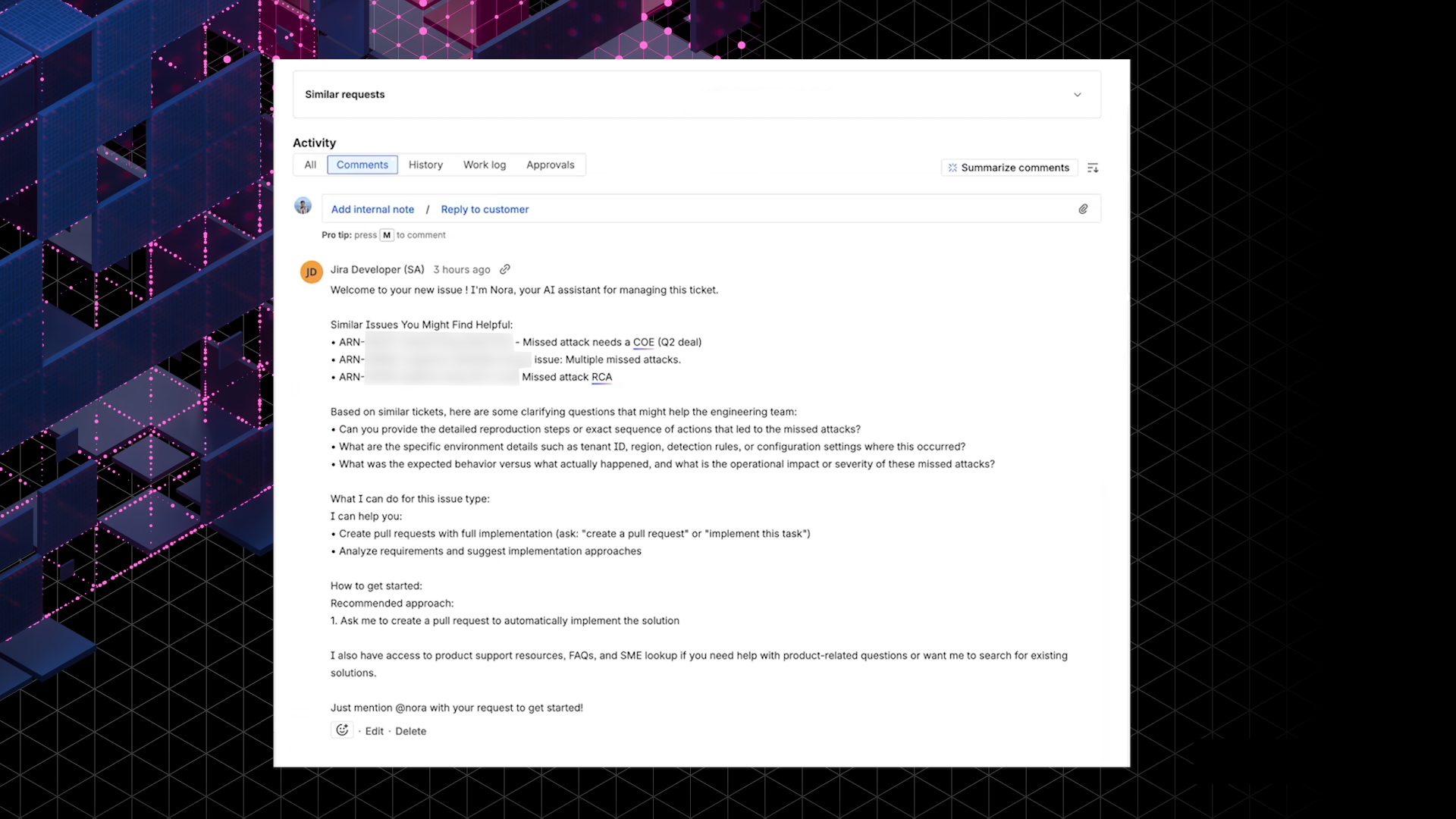
Once generated, the plan is automatically attached back to the Jira epic for visibility and collaboration.
Previously, TDDs and tech plans were incomplete due to missing context. Now, Nora can build detailed, end-to-end plans that reflect the real state of the codebase. Users can now prompt Nora to generate tasks from the technical plan, specifying available story points. Nora divides work accordingly, assigning point values to each task.
It uses the same contextual data it just analyzed, ensuring tasks are aligned with the tech plan and overall project goals. This closes the loop between planning and execution, reducing the manual translation of plans into actionable tickets.
These updates have also now improved user feedback and visibility. A new “working” indicator shows when Nora is actively processing a request, preventing users from thinking the system is unresponsive during longer runs (such as code analysis). This enhances trust and usability; users now understand what’s happening behind the scenes while Nora works autonomously.
The Impact
These new upgrades dramatically improve both output quality and user experience:
- Better consistency: Regardless of how teams attach context, Nora now interprets and unifies it automatically.
- Smarter outputs: Tech plans and tasks reflect the real project structure rather than generic templates.
- End-to-end autonomy: Nora can now go from epic to tech plan to task breakdown without manual handoffs.
- Higher confidence: With the working indicator, users know when Nora is active and can trust the system to finish the job.
In short, this update transforms the Orchestrator from a structured task generator into a code-aware project manager that understands the work it’s coordinating.
What's Next
With the foundation of context understanding now in place, the roadmap for the Jira Orchestrator is expanding fast:
- Multi-epic reasoning: Enable Nora to understand dependencies and relationships across different epics.
- Version control integration: Connect Jira orchestration directly with Git or other repositories to track implementation progress.
- Adaptive learning: Allow Nora to remember successful orchestration patterns and apply them across teams.
- Expanded autonomy: Move closer to a model where Nora not only generates tasks but also coordinates their execution, tracking completion and surfacing blockers.
Each iteration is bringing the orchestrator closer to actual AI-driven project orchestration, where humans focus on reviewing and refining, while Nora handles the rest.
Tushar’s continued work on the Jira Orchestrator demonstrates what AI orchestration looks like in practice: thoughtful, iterative progress toward real autonomy. By integrating code analysis, documentation parsing, and real-time task management, this update takes Nora one step closer to being a full-fledged AI project partner, enabling it to understand, plan, and manage work with intelligence and consistency.
