
NOTE: Demo visuals use either blurred real data or synthetic placeholders to protect customer privacy.
Raising the Reliability Bar
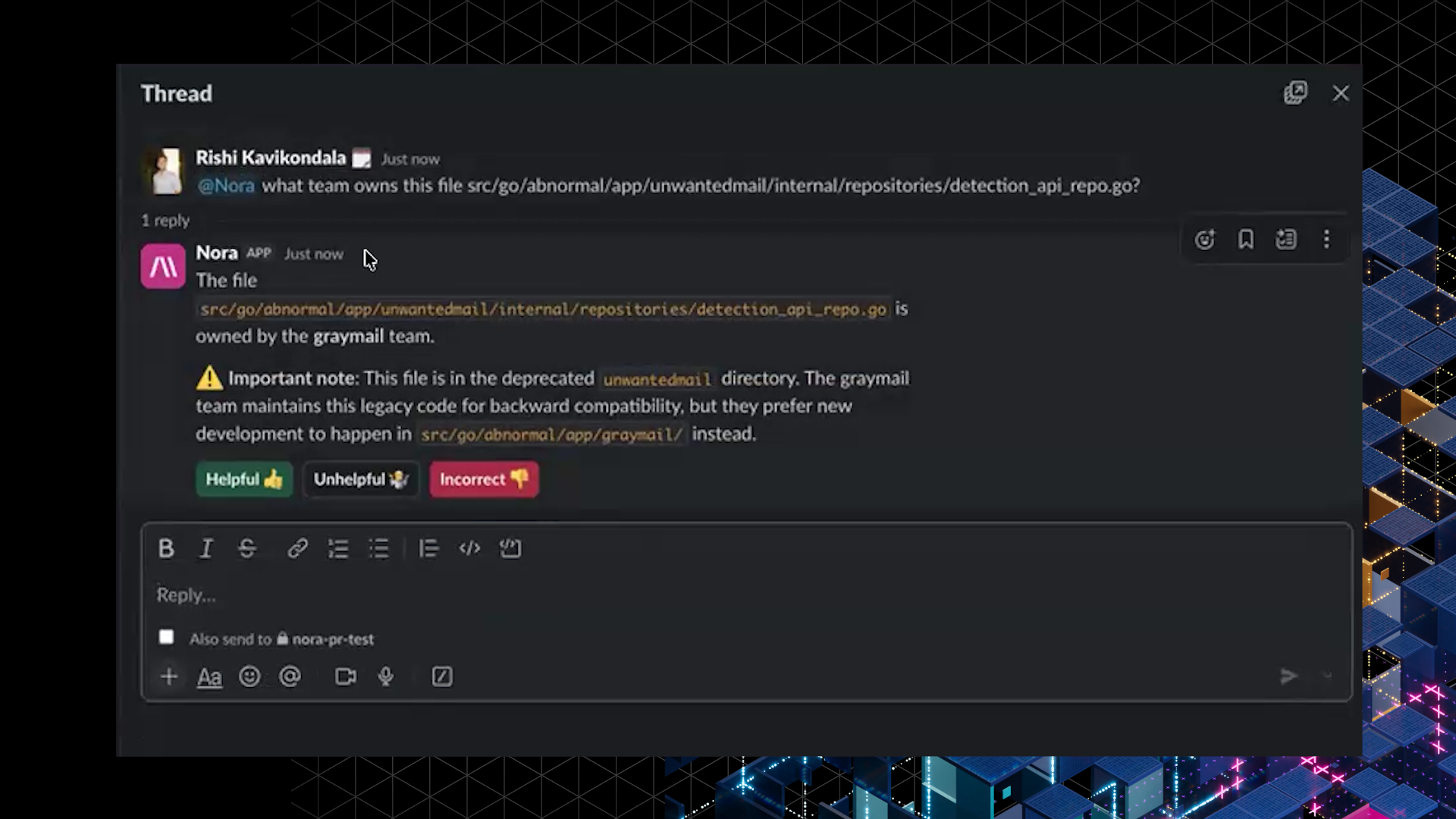
As more teams adopted Nora, the expectations rose. Engineers wanted confidence that it pulled the correct logs, ran the right queries, and pointed to the right code owners. Nora had proven fast. Now it needed to prove accurate.
- Ensuring correct log and metric retrieval across services.
- Verifying team ownership for each affected file or service.
- Building a feedback loop that improved Nora’s precision.
Rishi framed this phase as moving from “working” to “trustworthy.” Speed mattered early on, but scale demanded validation. By focusing on precision, ownership mapping, and user feedback, Nora began to act less like a prototype and more like a dependable teammate engineers could rely on during critical incidents.
Building Confidence into the Product
Rishi and collaborators added integrations that made Nora not only faster but also verifiable. Nora now performs light analysis of its own outputs and presents its findings through charts and summaries.
- Bedrock code interpreter generates quick metrics charts with Plotly.
- CloudWatch and Prometheus data are displayed visually in Slack.
- GoLinks are resolved automatically for accurate runbook access.
- Evaluation scripts verify data sources and ownership mappings.
- Slack search includes prior incidents for context.
Rishi noted that Nora is now available for any engineering team to use. After an initial trial with a handful of teams, the responder has been opened company-wide. Setup takes only minutes: teams add Nora to their alerts channel, run Edit Persona, and it immediately begins handling PagerDuty alerts automatically.
Reaching General Availability
Nora’s early access rollout covered nearly all engineering teams, and Rishi noted that the tool may move to general availability soon. That progression reflects its growing stability and the real-world impact already visible in daily operations. The tool automatically aligns alert timelines with log retrieval windows, delivering context the moment an incident begins.
- Near real-time synchronization between alerts and logs
- Visual summaries available at incident start
- Reliable correlation between alerts and prior responses
Nora’s learning feedback loop is also expanding. Teams now share which data sources are most helpful, shaping how Nora prioritizes signals. Engineers describe the process as collaborative. Nora improves in step with their usage patterns.
Cultural Signal: From Tool to Teammate
Peers describe Nora as a silent collaborator: always awake, always current. What began as a side project to speed up triage has become a shift in how the company responds to incidents. Teams talk about “adding Nora” the same way they’d onboard a new engineer. That quiet adoption curve is the strongest signal yet that AI-powered response is becoming part of the organization’s everyday rhythm.
