
Deep Research to Actionable Insight
At its core, Nora Research is built to answer a critical question: How do we go from a customer issue to a production fix within 24 hours?
The system aggregates signals from across the company through Gong calls, Jira (ARN) tickets, product FAQs, and codebase context. It then identifies root causes, proposes solutions, and feeds directly into code generation workflows.
But in early pilots, a key issue emerged: there was too much information, but not enough clarity.
Making Research Outputs Actually Usable
One of the biggest improvements in this iteration is a shift from long-form reports to concise, glanceable summaries. Instead of requiring engineers to read through pages of analysis, the system now:
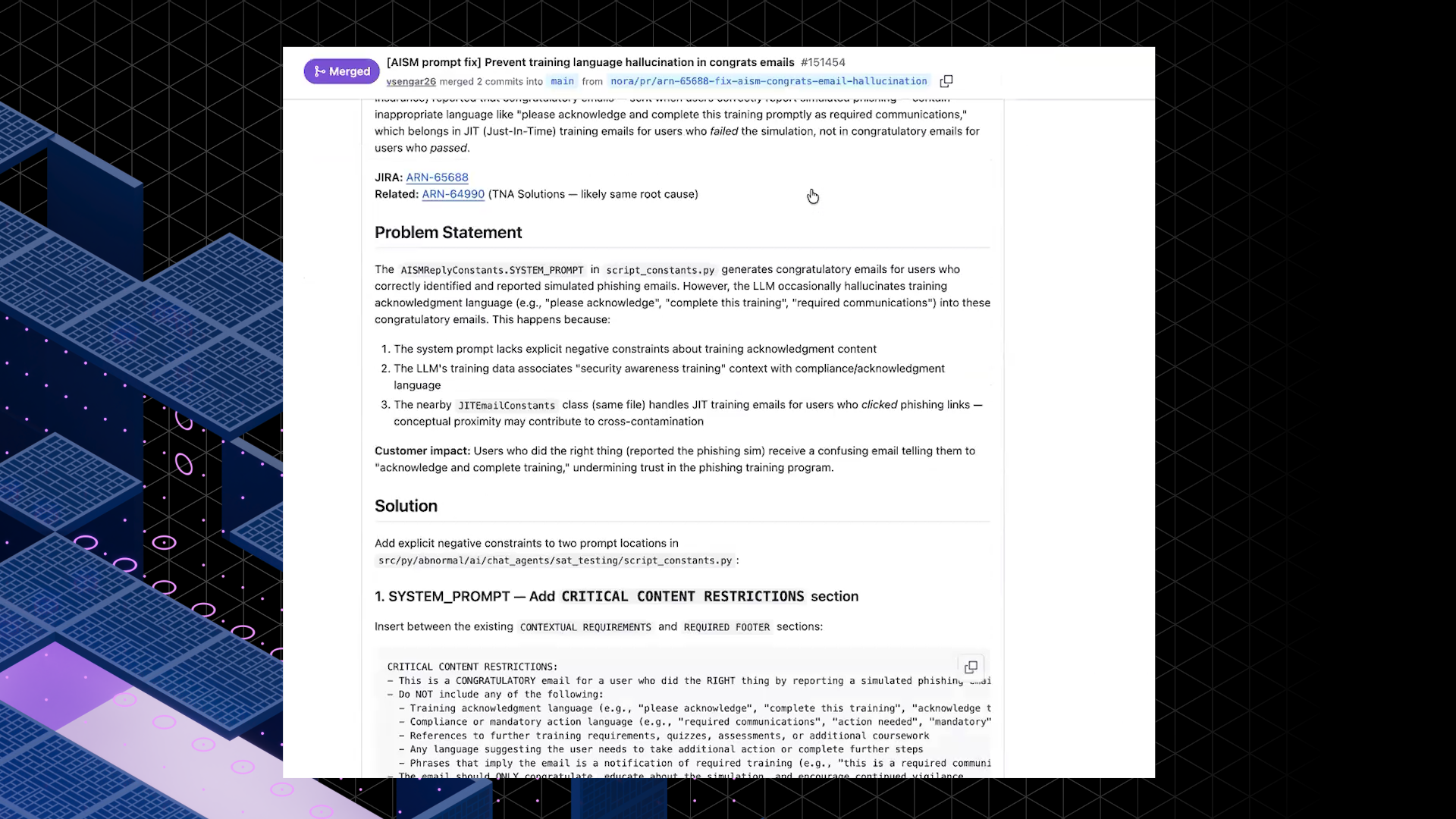
- surfaces the root cause and recommended solution upfront
- provides a quick, ~60-second overview
- allows optional expansion for deeper investigation.
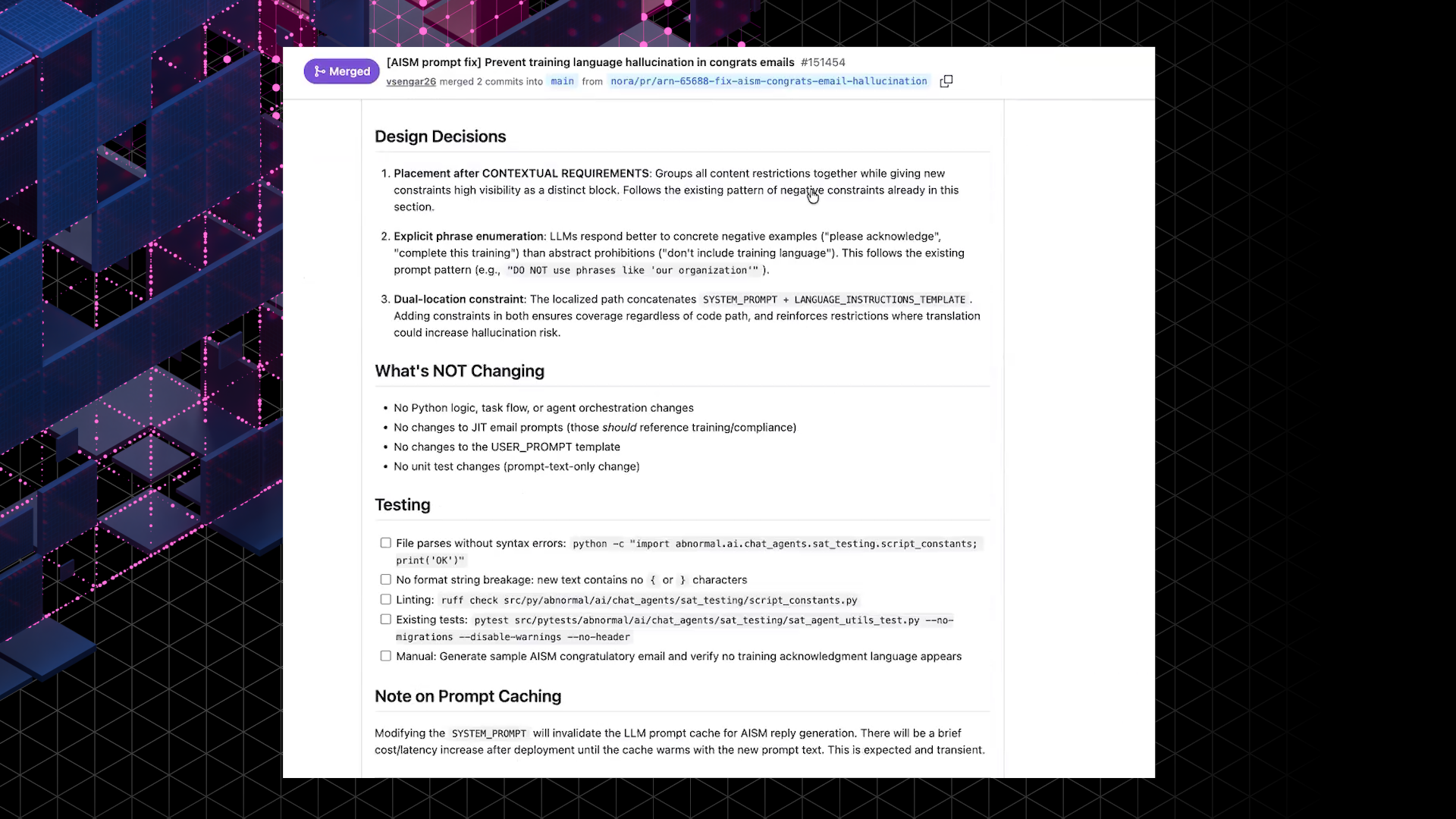
This change alone dramatically reduces time-to-understanding, especially for engineers juggling multiple tickets.
Separating Signal from Noise
Another major breakthrough was recognizing that not every ticket needs code. Previously, the system would sometimes generate PRs for configuration issues, propose fixes for non-code-related requests, and create unnecessary noise in engineering workflows.
Now, Nora Research first determines whether a ticket actually requires a code change, or if it’s a configuration, usage, or informational issue. Only then does it proceed to trigger Nora PR. This no-code detection layer is a key step toward smarter, more efficient automation.
The team also focused on improving usability across the workflow.
Key enhancements include:
- automatic labeling to trigger downstream PR generation
- Slack notifications when research or PRs are ready
- elimination of manual polling in Jira
These changes make the system feel less like a tool engineers have to monitor and more like an autonomous pipeline that delivers results when ready.
Why This Matters
The impact is already visible in real usage.
In one example a customer issue was raised, Nora Research identified the root cause, Nora PR generated a fix, the PR was approved and merged, and the issue was resolved: all within the same day.
This represents a shift from manual triage and multi-day turnaround to automated diagnosis and near real-time resolution.
By reducing verbosity, filtering out unnecessary work, and tightening the feedback loop, Nora Research moves closer to its ultimate goal to become a fully automated pipeline where customer feedback becomes production-ready fixes reliably, and at scale.
And as adoption grows across teams, the real unlock becomes clear: not just faster fixes, but a fundamentally new way of building and maintaining software.
